
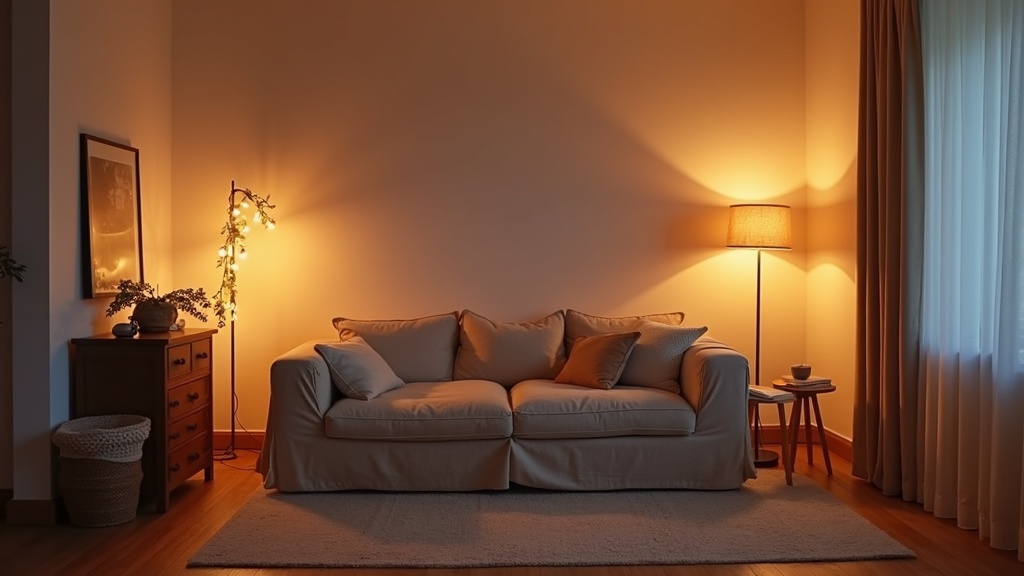
Most rental apartments share the same lighting problem: a single overhead fixture, a bulb that is too bright, and a room that never quite feels like yours. It is not a design flaw you have to live with.
Good lighting doesn't announce itself. It settles into the room and changes how it feels. And the good news is, renters have more options than ever, at prices that won't sting when move-out day comes.
Key points at a glance
- Plug-in dimmers and smart bulbs transform any lamp without touching the wiring.
- Layered light, floor lamps, sconces, and string lights, does more than any single overhead fixture.
- Keeping light sources below eye level (around 5'7") makes a room feel larger and calmer.
- Warm white LEDs at 2700K match the feel of incandescent light without the heat or cost.
- A simple room-by-room lighting plan keeps spending focused and results consistent.
- Every fix here is fully reversible, so your deposit stays safe.
What this guide gives you
Why Overhead Lighting Ruins a Room (and What to Do Instead)
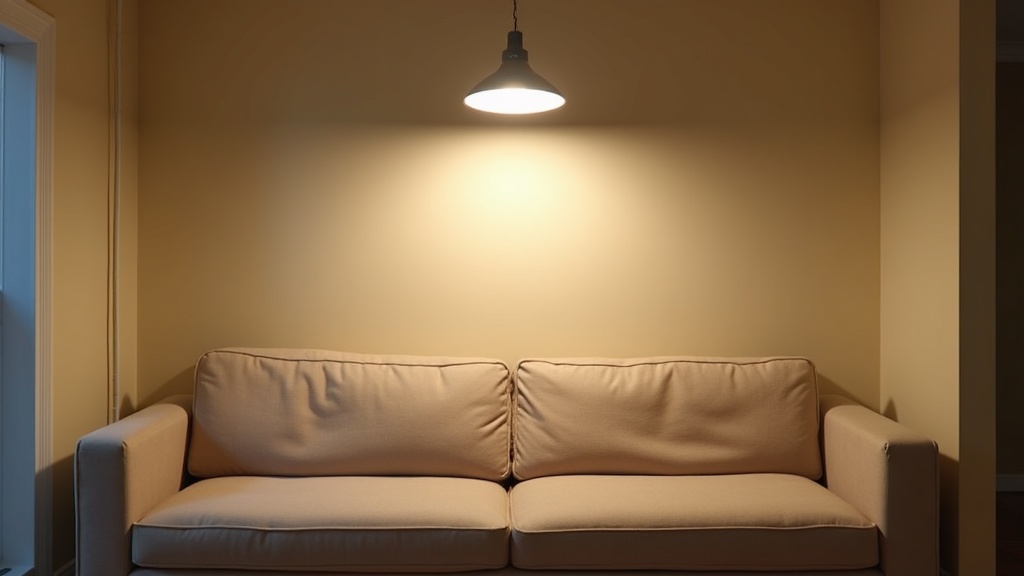
A single ceiling light floods a room from above. It flattens everything, creates harsh shadows, and signals to your brain that it's time to be productive, not rest.
Ambient overhead light has its place, but as the only source in a room, it works against comfort. The fix is not to remove it. It's to add other sources that compete with it, and then turn it off.
Think in terms of zones. A reading corner, a dining area, a spot by the sofa. Each zone gets its own light source, placed at a human scale. The ceiling fixture becomes a backup, not the star.
The Ground Rules: What Renters Can and Cannot Change
The rule is simple: if it requires touching the wiring, the answer is no. That means no replacing ceiling fixtures, no installing hardwired dimmer switches, no cutting into walls.
What you can do is more than enough:
- Swap bulbs in any existing lamp or fixture
- Add plug-in lamps anywhere there's an outlet
- Use a plug-in dimmer between any lamp and its socket
- Install peel-and-stick or battery-powered wall sconces
- Hang string lights with adhesive hooks
None of these require tools. All of them are reversible. Your deposit is safe.
Plug-In Dimmers and Smart Bulbs: The Easiest Place to Start
A plug-in dimmer switch costs around $8 to $15 and sits between any lamp cord and the wall socket. You plug the dimmer in, plug the lamp into the dimmer, and you have full control over the brightness, instantly.
The only catch: the bulb inside the lamp must be dimmable. Most LED bulbs now say "dimmable" on the box. Check before you buy.
Smart bulbs: a step up in control
Smart bulbs like the Philips Hue White or the IKEA Tradfri screw into any standard socket and connect to your phone via Wi-Fi or Bluetooth. No hub required for most entry-level options.
You can set schedules, dim from the couch, and adjust the color temperature, warmer in the evening, cooler when you need focus. For a renter, this is as close to a full lighting system as you can get without touching a single wire.
Did you know?
Standard dimmer switches installed in walls require the circuit to carry a neutral wire. Many older rental apartments do not have one, which is exactly why plug-in dimmers and smart bulbs exist as a practical alternative for the same effect.
Layered Light on a Budget: Lamps, Sconces, and Strings That Do Real Work
Layered light means at least three sources in any room you spend real time in. One ambient (general fill), one task (focused, for reading or cooking), one accent (decorative, for mood).
Floor lamps
A tall arc lamp behind a sofa or armchair gives warm upward light that bounces off the ceiling gently. Look for ones with fabric shades in linen or cotton, they diffuse light instead of directing it harshly.
Clip-on and peel-and-stick sconces
Battery-powered or plug-in wall sconces with adhesive mounts are now genuinely good. Brands like Lightess and EDISHINE make renter-friendly versions for under $30. Place them at about shoulder height on either side of a bed or sofa.
String lights
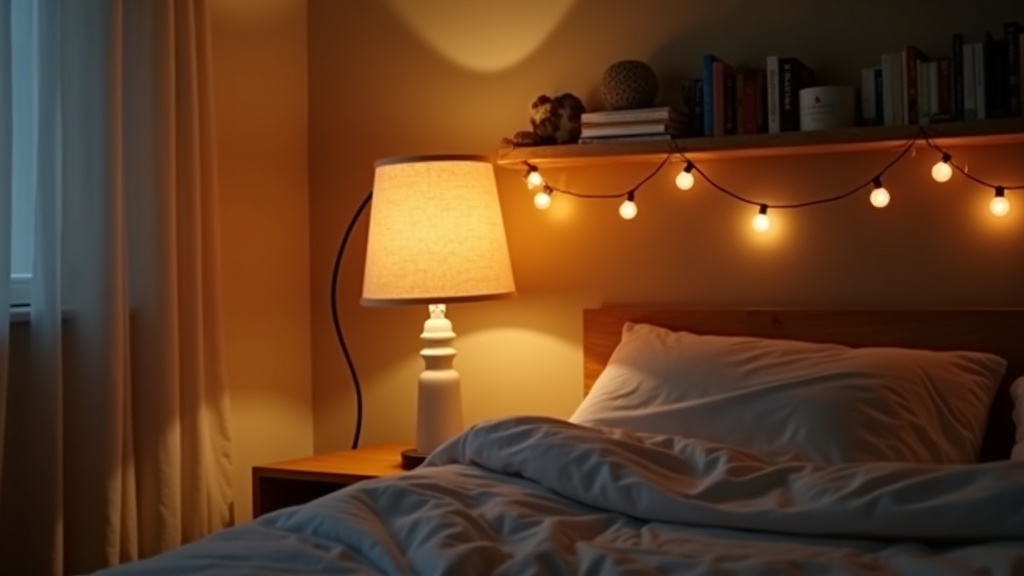
Not just for student rooms. Warm white fairy lights strung behind a headboard, along a shelf edge, or inside a glass jar create a glow that no lamp can replicate. 2700K or 2200K warm white only. Cool white string lights look like a dentist's waiting room.
The 5'7" Lighting Rule and How to Use It in a Small Rental
This is one of the most practical ideas in residential lighting: keep most of your light sources below eye level, roughly 5'7" or 170cm from the floor. Light that comes from below your eyeline reads as warm, intimate, and human-scaled.
Light that comes from above reads as institutional. There's a reason restaurants and hotels rarely rely on ceiling-only lighting.
In a small rental, this matters even more. A lamp at floor or table height pools light in the corner and draws the eye inward, which makes the room feel deeper. A single overhead light stretches the eye upward and makes the walls feel closer.
Practical application: add a table lamp on every surface you use regularly, a bedside table, a console, a kitchen counter. Even a small lamp at $12 from a thrift store, with a good bulb inside, changes the whole register of a room.
The Best Budget Dimmable Picks Across Every Price Point
| Product type | Price range | Best for | Renter-friendly? |
|---|---|---|---|
| Plug-in inline dimmer | $8, $15 | Any existing lamp | Yes, fully reversible |
| Dimmable LED bulb (2-pack) | $10, $18 | Any lamp socket | Yes, take them when you leave |
| Smart bulb (Bluetooth, no hub) | $15, $30 | Living room, bedroom lamps | Yes, screws in and out |
| Plug-in arc floor lamp | $35, $60 | Living room ambient layer | Yes, freestanding |
| Battery-powered wall sconce | $20, $40 | Bedside, hallways | Yes, adhesive mount |
| Warm white string lights (10m) | $10, $20 | Accent layer, shelves, beds | Yes, adhesive hooks only |
How to Make LED Lights Feel Warm Instead of Clinical
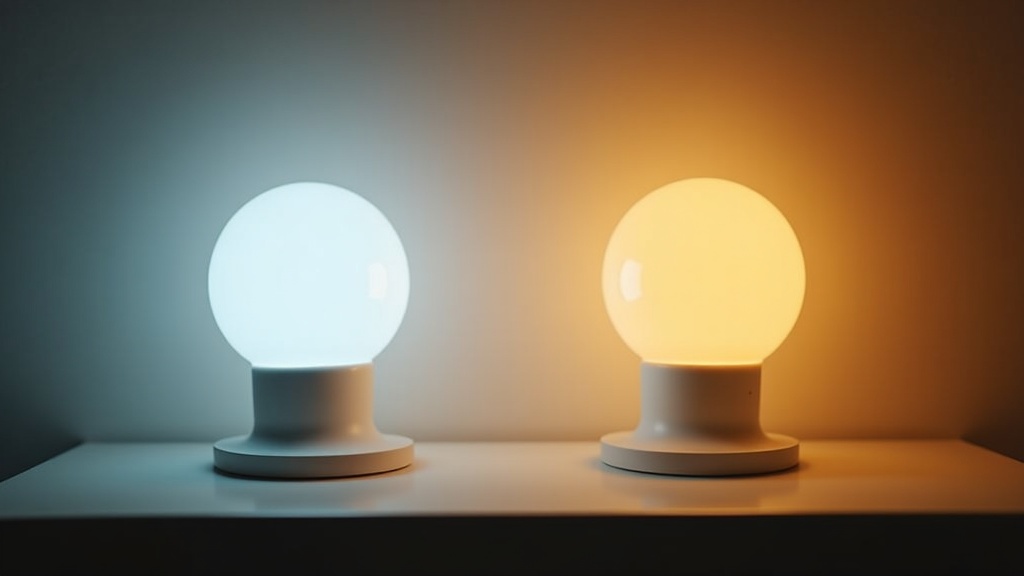
The single biggest mistake renters make is buying whatever LED bulb is cheapest without checking the color temperature. Color temperature is measured in Kelvin (K) and it is the difference between a room that feels like a spa and one that feels like a supermarket.
- 2200K, 2700K: warm, amber-toned, candle-like. Use this everywhere you want to relax.
- 3000K: soft white, slightly crisper. Works well in kitchens and bathrooms.
- 4000K and above: cool, bluish, energising. Fine for a home office, cold everywhere else.
For a cozy rental apartment, buy nothing above 2700K for living and sleeping spaces. Full stop.
Did you know?
Human eyes are more sensitive to blue-spectrum light in the evening because it suppresses melatonin production. Using warm 2700K bulbs after sunset has been shown in sleep research to improve sleep onset time by up to 20 minutes compared to cool white lighting.
Also check the CRI, Color Rendering Index. A score above 90 means colors in the room look true and rich. Below 80, everything looks a little flat and washed out. Most quality LED bulbs list CRI on the packaging.
One Room at a Time: A Simple Lighting Plan for Renters
Start with the room where you spend the most evening time. For most people, that's the living room or the bedroom. Not both at once.
Living room: the three-source rule
One floor lamp or arc lamp for ambient fill. One table lamp for a warmer accent. One string light or candle-style bulb lamp for the third layer. Turn off the overhead. Done.
Bedroom: low and warm
Two bedside lamps at table height, both with 2700K dimmable bulbs. A plug-in dimmer on at least one of them. String lights behind the headboard as an option for wind-down light. The ceiling fixture stays off after 9pm.
Kitchen: task first, then soften
Under-cabinet LED strip lights (plug-in, adhesive-mount) handle task lighting without you needing to touch a single wire. A small warm lamp on the counter near the dining area softens the space in the evenings.
The principle stays the same in every room: start with what you need to see, then add what makes you feel something. Light placed right does more for a room than any renovation. Work through it one space at a time, and the whole apartment shifts.


