
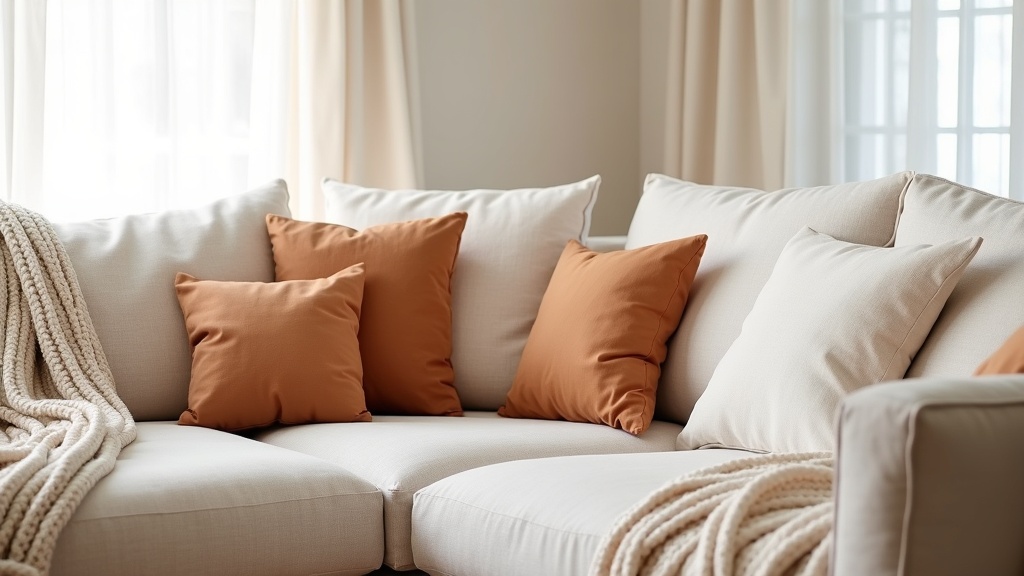
Most sofa styling goes wrong before anything is even purchased. The mistake is starting with objects, with a pillow you liked in a shop, a blanket that was on sale, rather than starting with how you want the room to feel when you walk in at the end of the day.
Get that feeling right first, and the decisions become simple. Not because there are no rules, but because the right question makes the rules almost irrelevant.
Key points at a glance
- Start with the mood of the room, not the color of your sofa.
- The 2-2-1 rule gives you a reliable starting structure without locking you in.
- A three-tone color palette, one anchor, one mid-tone, one accent, is almost always enough.
- Texture creates visual interest even when your entire palette is neutral.
- A throw looks most natural when it is placed with intent, not just tossed.
- Scale and proportion matter as much as color: one oversized pillow reads completely differently from two small ones.
What you will get from this guide
Start With How the Room Feels, Not How It Looks
Before you touch a single pillow, stand in the room. Notice the light. Morning rooms with east-facing windows call for cooler linens and softer blues. An evening room that catches low western sun belongs to warm ochres and deep terracotta.
The feeling you want is the brief. Calm and grounded? Reach for undyed wool and clay tones. Soft and inviting? Velvet and warm ivory work. Crisp and considered? Linen in natural or stone.
Everything else follows from that decision. Color, texture, quantity: they are all in service of a feeling, not a look.

The 2-2-1 Rule: A Starting Point, Not a Cage
The 2-2-1 throw pillow rule is a placement formula: two large pillows at the back, two medium pillows in front, and one smaller or differently shaped accent pillow in front of those. It creates depth and scale without crowding the seat.
It works because it mirrors how the eye naturally moves: large to small, back to front, grounded to playful.
But treat it as a scaffold, not a sentence. A two-seater sofa may only need a 2-1. A deep sectional can handle a 2-2-1-1. The principle is the same: graduated size, odd number of visual groups.
What the rule is really about
- Visual hierarchy: the eye needs somewhere to land first
- Proportion: pillows should fit the sofa, not compete with it
- Breathing room: leave enough sofa visible that it still reads as a sofa
Did you know?
Interior stylists working on magazine shoots typically use an odd number of visual groups, never an even number, because the human eye finds asymmetry more natural to read than symmetry. The 2-2-1 achieves this by grouping the five pillows into three visual layers, not five individual objects.
Building a Color Palette That Holds Together
Three tones. That is usually enough. One anchor color (your dominant, often pulled from the sofa or rug), one mid-tone that bridges, and one accent that has a little more life in it.
Your throw blanket and pillow set does not need to match. It needs to belong to the same family. Think of a sand pillow, a warm taupe cushion, and a deep rust throw. They are not the same color. But they share the same warmth, the same underlying temperature.
A common mistake: mixing warm and cool tones without a mediator. A warm beige sofa with a cool blue-grey pillow will always feel slightly off. Add a natural linen pillow between them and the tension dissolves.
Texture Is Doing More Work Than You Think
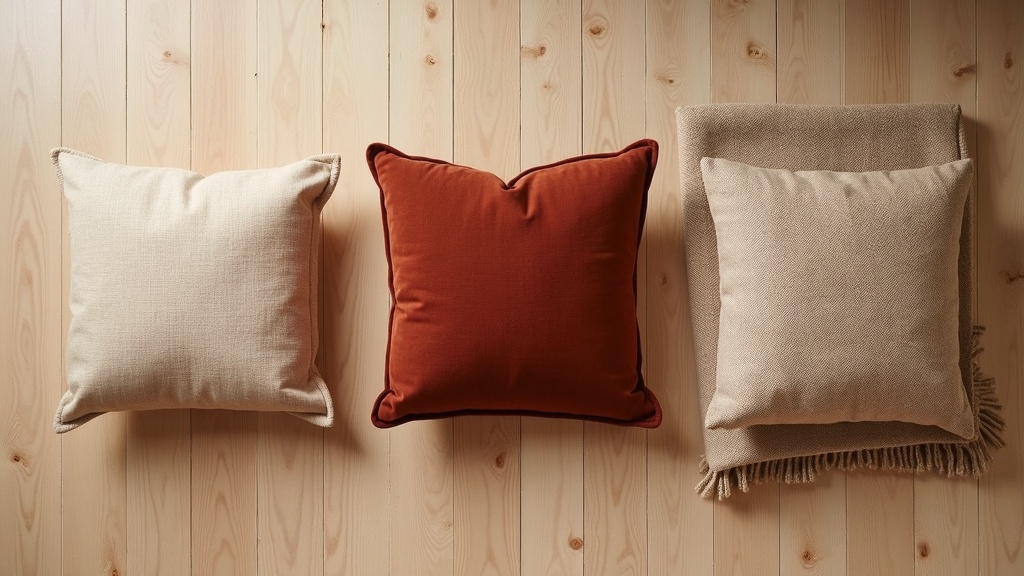
When your palette is quiet, which it often should be, texture is what gives the arrangement life. A chunky knit sits differently from a flat woven linen. Velvet catches light in a way that matte cotton simply does not.
Vary your surfaces deliberately. One matte, one woven, one with pile. That combination reads as layered and considered, even if every piece is within one or two tones of the same color.
The same rule applies to your throw. A bouclé blanket next to a smooth velvet pillow creates contrast that the eye enjoys. A chunky knit next to a rough linen reads as too similar in weight. They cancel each other out.
| Fabric | Best used as | Pairs well with | Season feel |
|---|---|---|---|
| Chunky knit wool | Throw blanket, accent pillow | Smooth velvet, flat linen | Autumn, winter |
| Washed linen | Pillow cover, light throw | Bouclé, cotton canvas | Spring, summer |
| Velvet | Accent pillow | Matte linen, undyed wool | Year-round, stronger in winter |
| Bouclé | Pillow cover, small throw | Smooth cotton, fine linen | Autumn, winter |
| Cotton canvas | Everyday pillow cover | Linen, lightweight wool | Spring, summer |
How to Fold and Place a Throw So It Looks Effortless
A throw that looks effortless is never actually thrown. It is placed. The difference is intention.
Three placements that work consistently:
- The armrest drape: fold the blanket lengthwise into thirds, lay it over one armrest so roughly a third falls down the front and two-thirds extend over the seat. Asymmetrical and natural.
- The seat fold: fold loosely into a broad rectangle, place it flat across one seat cushion. Simple, tidy, still inviting.
- The backrest anchor: drape it behind and over the back of the sofa at one end, as if someone just set it down. Works especially well with a large blanket on a deep sofa.
Avoid centering the throw. Centering creates symmetry where there should be ease.
Did you know?
Swedish interior design is guided by the concept of lagom: not too much, not too little. Applied to soft furnishings, it suggests that one well-chosen throw does more for a room than three decorative ones. The goal is comfort that reads as deliberate, not abundance for its own sake.
Scaling Your Pillows Right: Size, Quantity, and Arrangement
Standard sofa pillows run 18 to 20 inches square. These are your back-row workhorses. Drop to 16 inches for the middle row, and use a 12-inch lumbar or round pillow as your front accent.
A three-seater sofa can hold five pillows comfortably using the 2-2-1 arrangement. A two-seater is better served by three. More than that and the sofa stops functioning as a sofa.
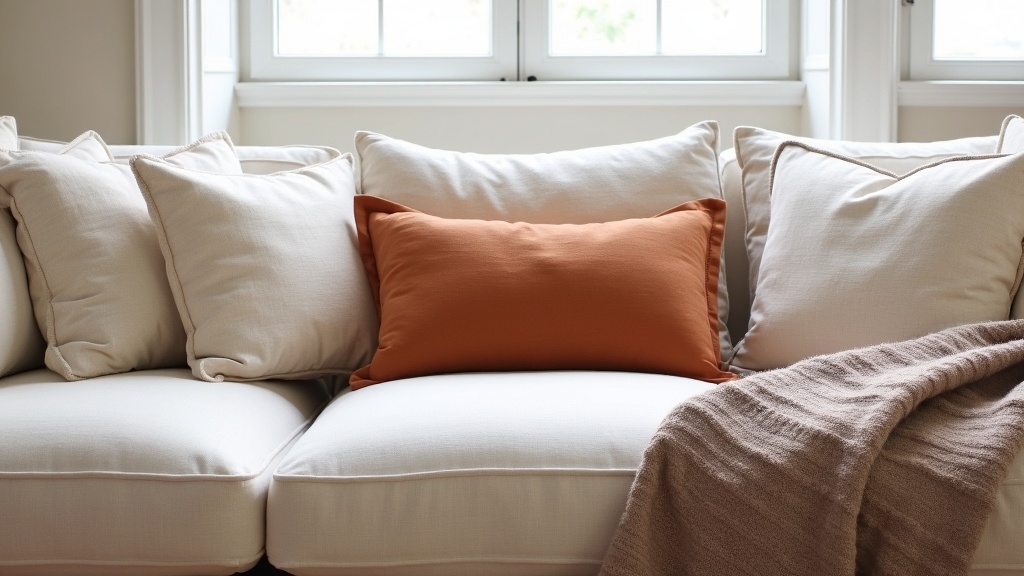
When you mix square and rectangular (lumbar) pillows, place the lumbar in front. It anchors the arrangement horizontally and prevents the stack from feeling like a wall.
Bed vs. Sofa: Where the Rules Shift
On a sofa, the throw is functional. It gets used, moved, refolded. Style it for ease. On a bed, the throw is mostly visual: it adds a layer of warmth to the eye before it adds one to the body.
For a bed, fold the throw in thirds and lay it across the foot. The width should stop just short of the full bed width, leaving the fitted sheet or duvet visible at the sides. This frames the bed rather than covering it.
Pillow quantity scales up on a bed. A king bed can hold two Euro shams (26 inches), two standard pillows, and two accent pillows without feeling cluttered. The same bed with seven pillows feels staged rather than lived in.
A quick reference
- Sofa throw: one blanket, placed with asymmetry, functional and accessible
- Bed throw: one or two layers folded at the foot, primarily visual
- Reading chair: one small throw loosely folded over the armrest or draped over the back is enough
The One Question to Ask Before You Buy Anything
Here it is: does this belong to what I already have, or does it ask for attention on its own?
The best pieces belong. They are the ones you stop noticing after a week because they simply fit. A pillow that demands to be seen every time you walk in the room will exhaust you before the season changes.
Hold the new piece against something already in the room before buying. Not in the shop under artificial light. At home, in natural light, next to what it will actually live with. If it settles in, it belongs. If it competes, it does not.
That one test replaces most of the guesswork. Buy less, but buy things that last. That is lagom applied to a sofa.


