
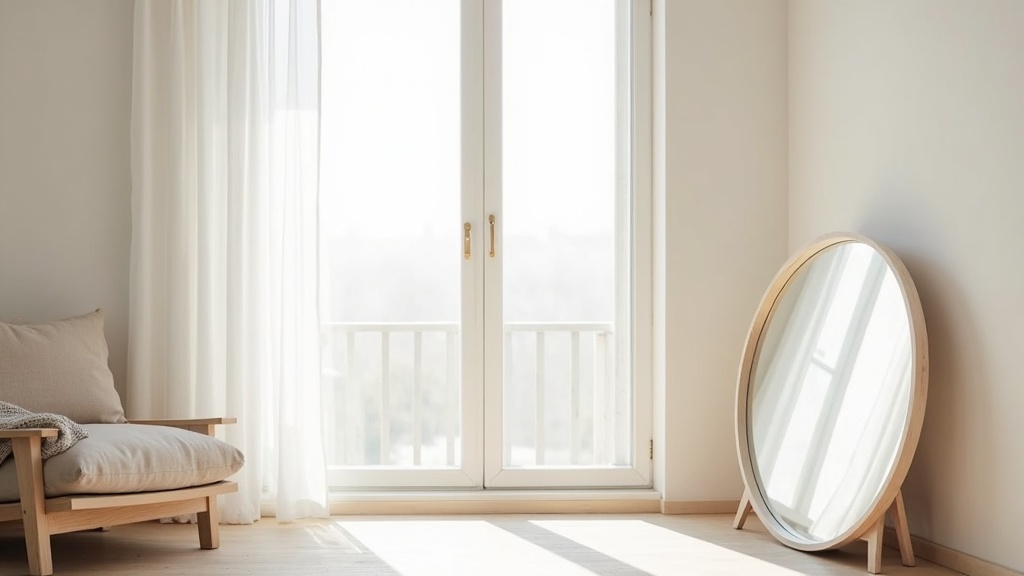
Most rooms have more light potential than they show. The problem is rarely the window. It is almost always what surrounds it, sits in front of it, or covers it.
You do not need a skylight or a new floor plan. You need to stop fighting the light you already have, and start working with it.
Key points at a glance
- Blocked windows are the most common reason rooms feel dark, and the fix is free.
- Mirrors placed opposite or adjacent to a window can meaningfully double perceived brightness.
- Paint with a light reflectance value (LRV) above 70 makes walls work like soft light sources.
- Low, bulky furniture absorbs light. Slimmer legs and lower profiles keep the room open.
- In windowless rooms, layered artificial lighting that mimics daylight color is a genuine solution.
- Lagom applies here: the goal is enough light, well distributed, not a room that feels overexposed.
What this guide gives you
Why Natural Light Changes More Than Just Brightness
Natural light does not just help you see. It regulates your circadian rhythm, lifts your mood, and makes a room feel larger than its actual square footage. Research from the World Green Building Council links daylight exposure in indoor spaces to better sleep, higher alertness, and reduced stress.
A room that feels heavy often is not dark in absolute terms. It is dim in the wrong places, or bright in a single spot while shadows pool around the edges. The goal is distribution, not intensity.
Did you know?
A study published in the Journal of Clinical Sleep Medicine found that office workers seated near windows got 46 minutes more sleep per night on average than those without daylight exposure at work. The same principle applies at home.
Start With Your Windows: What You May Be Blocking
Before buying anything, look at your windows with fresh eyes. Heavy curtains, blinds left half-closed, furniture pushed against the glass, and overgrown plants on the sill are the four most common light thieves.
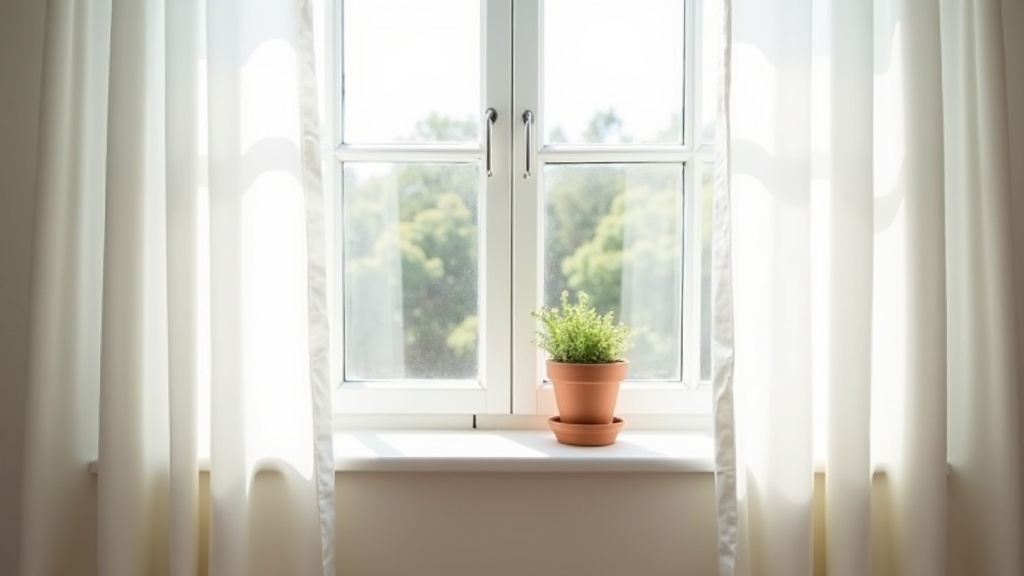
Swap heavy drapes for sheer linen panels. Pull furniture at least 30 cm away from the window zone. Clean the glass, inside and out. These three steps cost nothing and often produce an immediate visible difference.
Window treatments that work with light
- Sheer linen or cotton voile: diffuses glare without blocking daylight
- Roman blinds in white or off-white: stack neatly above the frame when open
- Top-down bottom-up blinds: ideal for privacy without sacrificing the upper light
- No treatment at all: genuinely underrated in rooms that face north or east
How Mirrors Actually Work (and Where to Put Them)
A mirror does not create light. It catches it, redirects it, and makes the room feel like it holds more of it. The placement matters more than the size.
The most effective position: directly opposite or at a 90-degree angle to the main window. This throws light back across the room into the corners that daylight cannot reach naturally.
A single large mirror on a wall adjacent to a window outperforms three small decorative mirrors scattered around the room. One well-placed piece does the work quietly.
Did you know?
The Versailles Hall of Mirrors was designed in 1678 specifically to amplify candlelight. The 357 mirrors facing the garden windows turned a dim interior into a space that felt lit from within. The physics have not changed.
The Role of Paint, Ceiling Color, and Reflective Surfaces
Paint color has a measurable quality called Light Reflectance Value (LRV), scored from 0 (pure black) to 100 (pure white). A wall with an LRV of 75 reflects roughly three times more light than one at 40.
Most people paint ceilings white and walls a mid-tone, then wonder why the room still feels enclosed. Try it the other way: keep walls soft and pale, and paint the ceiling a warm white with a very slight cream undertone. It reflects light down gently instead of bouncing it cold.
| Surface / Material | LRV Range | Best Used |
|---|---|---|
| Pure white paint (eg. Farrow & Ball All White) | 84–92 | North-facing rooms, ceilings |
| Warm off-white (eg. Jotun Whisper) | 72–80 | Living rooms, bedrooms |
| Light sage or greige | 50–65 | Accent walls in well-lit rooms only |
| Polished plaster or satin finish | Varies, adds sheen | Hallways, bathrooms |
| Dark charcoal or forest green | Below 20 | Only in rooms with excellent daylight |
Glossy surfaces, light-toned wooden floors, and glass-topped side tables all contribute to how light moves through a room. Matte dark flooring absorbs light from below. A pale rug in the center of a dark-floored room can noticeably lift the lower half of the space.
Furniture Placement and Height: The Quiet Culprits
A tall, dark bookcase placed between a window and the center of the room blocks more light than you realize. Light travels in a line. Anything in that line casts a shadow.
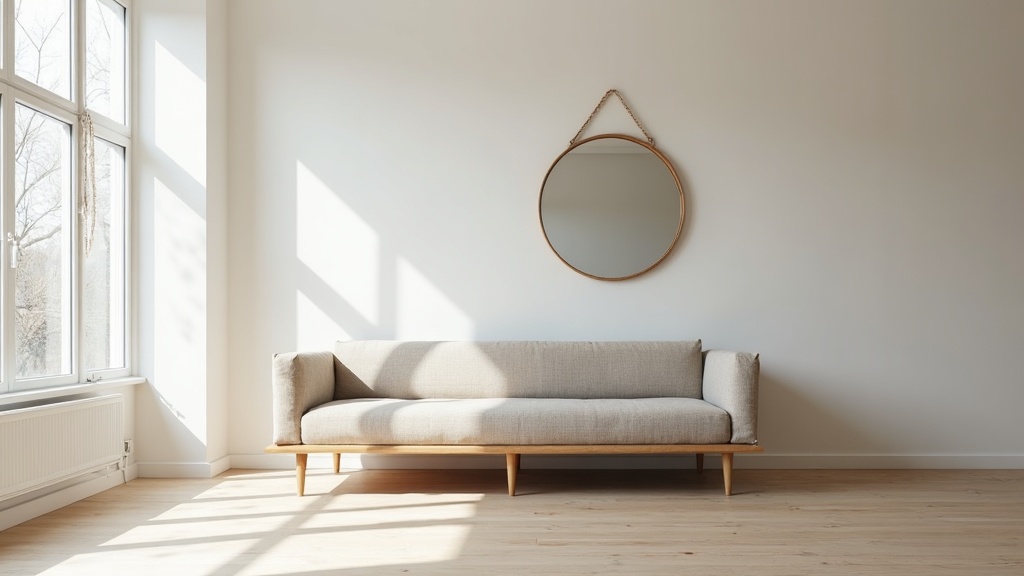
Keep tall pieces against walls that run parallel to your windows, not perpendicular to them. Choose furniture with legs over floor-level sofas and cabinets. That gap between the base and the floor lets light travel underneath and makes the room feel lifted.
How to Bring Light Into a Room With No Windows
A room with no windows is a real constraint. It is also a solvable one. The approach shifts from redirecting daylight to borrowing and simulating it.
Structural borrowing (no renovation required)
- Interior glass panels or borrowed light panels in a door can pass light from an adjacent bright room without removing walls
- Leaving a door open between a bright hallway and a dark room is more effective than it sounds
- Light tubes (tubular daylighting devices) can be retrofitted through a ceiling with minimal disruption, channeling outdoor light down into a room
Surface strategy
In a windowless room, every surface becomes a light source. Paint everything pale. Use high-gloss or satin paint on at least one wall. Add a large mirror. Choose furniture in light ash, white lacquer, or natural linen.
When Natural Light Is Not Enough: Simulating It Well
There are times of year, and rooms, where natural light simply runs out. The answer is not to flood the space with harsh overhead lighting. It is to layer sources that mimic what daylight does.
Daylight has a color temperature of roughly 5000K to 6500K. Most homes use bulbs around 2700K to 3000K, which reads as warm and amber. For rooms where you want to simulate natural light, choose bulbs in the 4000K to 5000K range: clean, neutral, and close to the color of a bright overcast sky.
The layering principle
- Ambient base: ceiling or recessed lights at 4000K to simulate overhead daylight
- Task layer: a desk lamp or reading lamp that adds focus without creating dark contrast
- Accent: a floor lamp angled toward the ceiling to bounce soft fill light across the room
Full-spectrum LED bulbs and SAD lamps that reach 10,000 lux are a genuine option for darker months. They are not just a wellness product. They change how a room reads in the morning.
The Lagom Principle Applied to Light
Lagom is a Swedish concept that does not translate neatly. It means something close to: the right amount. Not too much, not too little. Applied to light, it means a room that feels easy to be in at any hour, not one that is blinding at noon and gloomy by three.
Good lighting does not announce itself. It settles into the room and changes how it feels. That is the goal: not a bright room, but a room that feels right.
Where to start: a simple priority order
If you do only three things, do these. They cost little and change a lot.
- Clear the window zone. Move furniture, trim plants, swap heavy curtains for sheers.
- Add one large mirror on the wall opposite or adjacent to your main window.
- Repaint at least one wall in a color with an LRV above 70. Start with the wall that faces the window.
After those three, consider furniture height, floor color, and artificial layering. Each step compounds the one before it. The room will not look renovated. It will just feel lighter, and that is precisely the point.


