
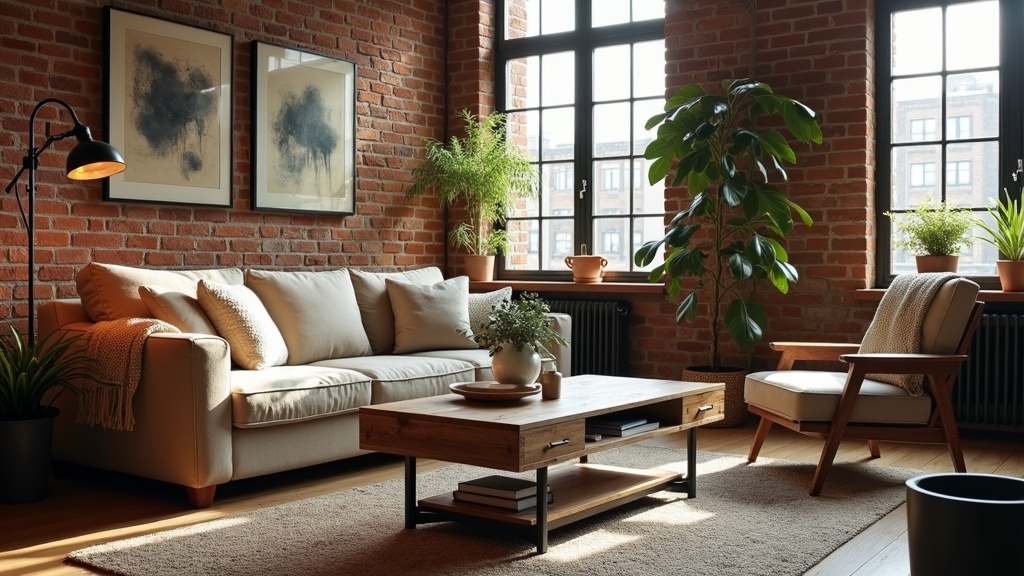
Industrial style has a reputation for being expensive. Raw concrete, bespoke steel shelving, salvaged warehouse doors: the Pinterest version costs a fortune. But the aesthetic itself was born in thrift, in repurposed factories and bare-bones apartments. Getting it right on a budget isn't a compromise. It's actually closer to the original spirit.
The rooms that work best aren't the ones with the most stuff. They're the ones where every piece has weight and reason. That's something you can achieve with patience and a clear eye, not a large budget.
Key points at a glance
- Industrial style is budget-friendly by nature: raw materials are often cheaper than polished finishes.
- You need three core elements: exposed texture, metal accents, and warm light. Everything else is optional.
- Warm lighting is what stops an industrial room from feeling cold or clinical.
- The 60-30-10 colour rule keeps the palette grounded without becoming monotonous.
- In small rooms, scale and negative space matter more than the number of pieces.
- Knowing when to stop is the hardest skill, and the most important one.
What this guide gives you
Why Industrial Style Works Well on a Budget
The industrial aesthetic celebrates material honesty. Bare concrete, unfinished steel, reclaimed timber: these aren't expensive finishes. They're what's left when you strip away the expensive ones.
That's a genuine advantage. You're not hiding flaws behind veneer or paint. You're leaning into them. A scuffed wooden beam doesn't need sanding. A mismatched metal bracket reads as intentional. The aesthetic absorbs imperfection and calls it character.
Thrift stores, salvage yards, and marketplace apps are better sources for this style than any furniture retailer. A rusted factory stool from a reclamation yard costs less than a replica from a high-street chain, and it looks ten times more convincing.
The Core Elements: What You Actually Need (and What You Can Skip)
Three things define an industrial living room. Get these right, and the room works. Miss them, and no amount of Edison bulbs will save it.
- Exposed texture on at least one surface. A brick wall, rough plaster, bare concrete, or even a large panel of raw plywood. One surface is enough.
- Metal in the right places. Light fittings, shelving brackets, table legs, or a single statement frame. Black or dark gunmetal reads best.
- Warm, layered light. This is non-negotiable. Without it, the room feels like a basement, not a living space.
What you can skip: exposed ductwork (usually impractical in a home), concrete floors (expensive to lay), and oversized factory-style furniture. Scale your ambition to your space. A small flat doesn't need a ten-seat reclaimed dining table.
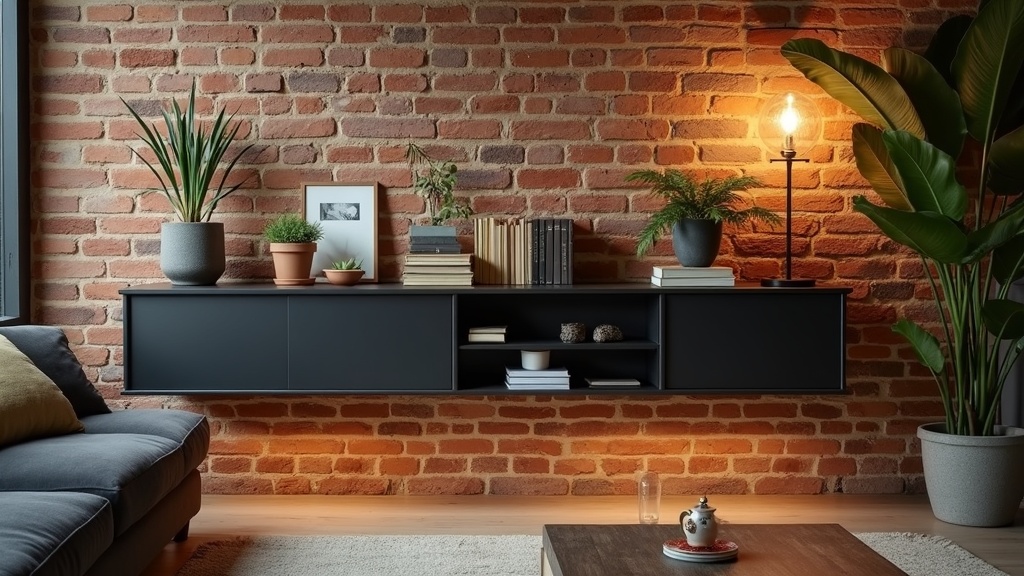
Walls and Floors: Raw Texture Without the Renovation Bill
You don't need to strip back plaster or pour concrete to get the right feel. Several options work without a contractor.
For walls
- Exposed brick paint effect using textured plaster, widely available and inexpensive.
- Dark matte paint in charcoal, slate grey, or warm off-black. One feature wall is enough.
- Real brick slips (thin brick tiles): more affordable than demolishing a wall, and convincing close up.
For floors
- Concrete-effect vinyl planks cost a fraction of poured concrete and work in rentals.
- Dark-stained or grey-washed wood laminate reads as industrial without the cost.
- Leave bare floorboards as-is if you have them. A worn patina is an asset here.
Did you know?
Brick slips, the thin tile-format bricks used for feature walls, typically cost between £30 and £60 per square metre installed. A full demolition to reveal original brickwork can run to ten times that, with no guarantee of what's underneath.
Furniture That Earns Its Place: Metal, Wood, and the Right Proportions
Industrial style furniture should feel purposeful and slightly utilitarian. It doesn't need to be precious. It needs to look like it was chosen because it works, not because it matches.
The best combinations pair a soft, upholstered sofa with harder-edged pieces: a metal-framed coffee table, a reclaimed wood console, a simple steel shelving unit. The contrast is the point.
| Piece | Budget option | What to look for |
|---|---|---|
| Sofa | Second-hand linen or canvas, neutral tone | Simple lines, no visible feet or metal legs |
| Coffee table | Steel-frame with wood top, marketplace finds | Weight and solidity; avoid glass |
| Shelving | Pipe and reclaimed wood, DIY or flat-pack | Black pipe fittings, rough-sawn timber |
| Side table | Industrial stool, vintage metal drum | Function first; height and surface area |
| Accent chair | Leather or faux-leather, minimal stitching | Dark tones; avoid pattern |
One principle to hold onto: proportion matters more than price. A cheap piece in the right scale reads better than an expensive one that overwhelms the room.
Light as a Design Tool: How Industrial Rooms Stay Warm, Not Cold
This is where most industrial rooms go wrong. The look suggests stark, bright, overhead light. That's exactly what you shouldn't do.
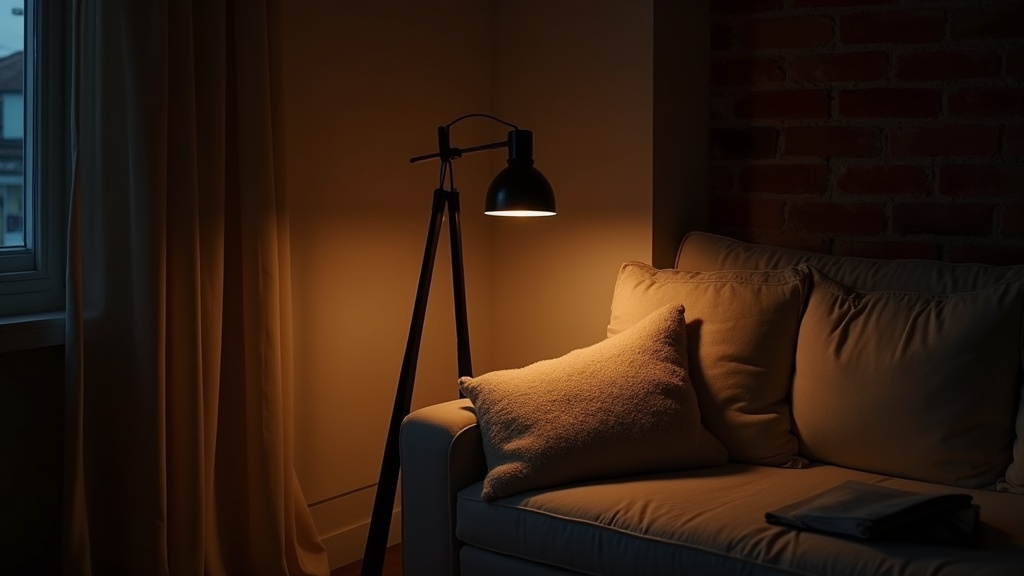
Good lighting doesn't announce itself. It settles into the room and changes how it feels. In an industrial space, that means multiple warm light sources placed low: floor lamps, table lamps, wall sconces at eye level, and Edison-style filament bulbs where the fitting allows.
The layering rule
- Overhead light: dimmed or on a warm bulb, used only as fill.
- Task light: one strong, directed source, usually a floor lamp with an arm.
- Ambient light: two or three small lamps at low height, creating warmth in corners.
A single pendant with a cage or metal shade above the coffee table anchors the room and adds the right aesthetic note without costing much. Light placed right does more for a room than any renovation.
The 60-30-10 Rule Applied to an Industrial Palette
Industrial palettes are narrow by nature: charcoal, warm grey, off-white, raw wood tones, black metal. The risk is monotony. The 60-30-10 rule keeps it alive without breaking the aesthetic.
- 60% dominant tone: a neutral, usually the walls and large furniture. Warm grey or off-white.
- 30% secondary tone: deeper and richer. Charcoal, dark brown, aged leather.
- 10% accent: the one unexpected note. Olive green, rust, aged brass, or dusty terracotta.
That 10% is where a cozy industrial living room separates itself from a cold, corporate one. A terracotta pot. A rust-coloured cushion. A brass reading lamp. One warm note is enough.
Did you know?
The 60-30-10 rule is a proportion guideline used by professional interior designers since at least the 1950s. It works because it mirrors the way the eye naturally moves through a room, resting on dominant surfaces and drawn to smaller points of contrast.
Small Industrial Living Rooms: How to Keep the Look from Feeling Heavy
Industrial elements have visual weight. Dark tones, dense materials, strong lines: in a small room, these can quickly feel oppressive.
The fix isn't to abandon the style. It's to be more selective.
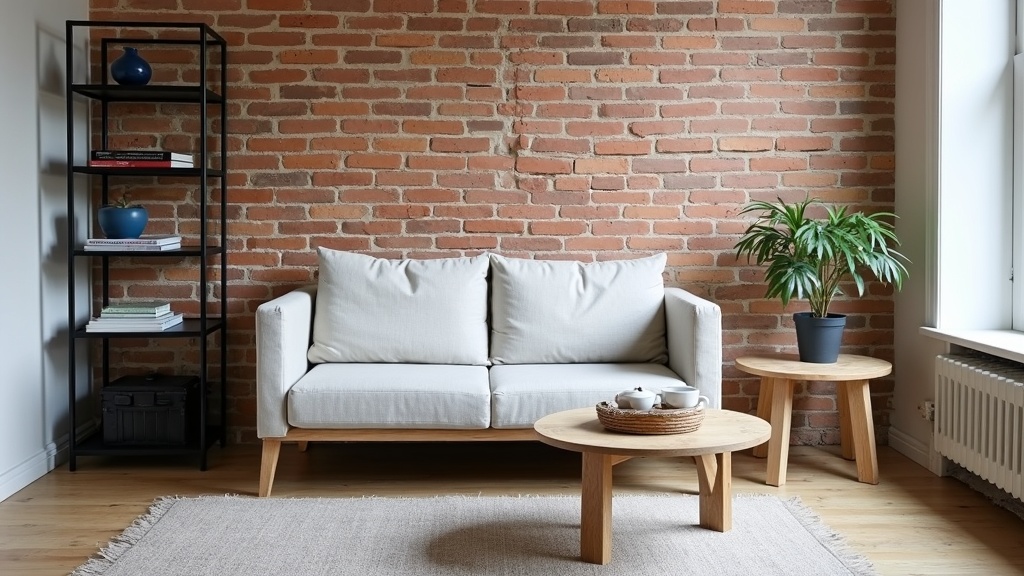
- Use one textured surface, not three. One brick wall, clean everywhere else.
- Choose furniture with visible legs. It creates a sense of floor space and reduces visual mass.
- Keep metal accents slim: thin-frame shelving, narrow table legs, small pendant rather than large cage shade.
- Add a mirror with a simple metal frame. It doubles the light and opens the room without any structural work.
- Leave breathing room between pieces. Negative space is not wasted space.
A small industrial living room on a budget works best when it's edited hard. Three considered pieces beat eight competing ones every time.
Is Industrial Style Still Relevant in 2026?
It's a fair question. The look peaked in the mid-2010s and has had its share of over-saturation. But industrial style, done with care, was never really a trend. It's a sensibility.
What's shifting is how it's being applied. The harshest, most minimal versions are softening. Rustic industrial living rooms that mix reclaimed wood, worn leather, and handmade ceramics feel more relevant than the cold-concrete aesthetic of a decade ago. So does the overlap with Scandinavian interiors: the same honesty about materials, the same resistance to ornament for its own sake.
Modern industrial living room ideas in 2026 lean warmer, softer, and more layered. That happens to be easier to achieve on a budget, because warmth comes from texture and light, not from expensive finishes.
The Lagom Approach: Knowing When to Stop
Lagom is the Swedish concept of just enough. Not too much, not too little. It's the hardest part of decorating, because the temptation is always to add one more thing.
The best pieces are the ones you stop noticing, because they simply belong. When a room reaches that point, it's done. Not finished in the sense of complete, but settled. It has found its own weight.
With an industrial living room on a budget, the lagom principle is also practical. You don't have money to fill every corner, so you choose carefully and you wait. A room that builds slowly, piece by piece, tends to end up more coherent than one furnished in a single weekend.
Your starting point: a practical sequence
Rather than buying everything at once, work through this order. Each step creates a foundation for the next.
- Fix the walls first. Choose your one textured surface or paint a feature wall in your dominant tone. This sets everything else.
- Sort the lighting before the furniture. Place lamps, test warmth, find your low sources. It costs little and changes everything.
- Bring in the sofa. Choose neutral, choose simple. This is your 60% dominant piece.
- Add one metal-framed piece, a shelving unit or coffee table. This anchors the industrial note.
- Layer texture slowly. A wool throw, a jute rug, a ceramic pot. One at a time, over weeks.
- Stop before you think you're finished. Live with it for a month. The things that are missing will make themselves obvious. The things you don't miss, you didn't need.


