
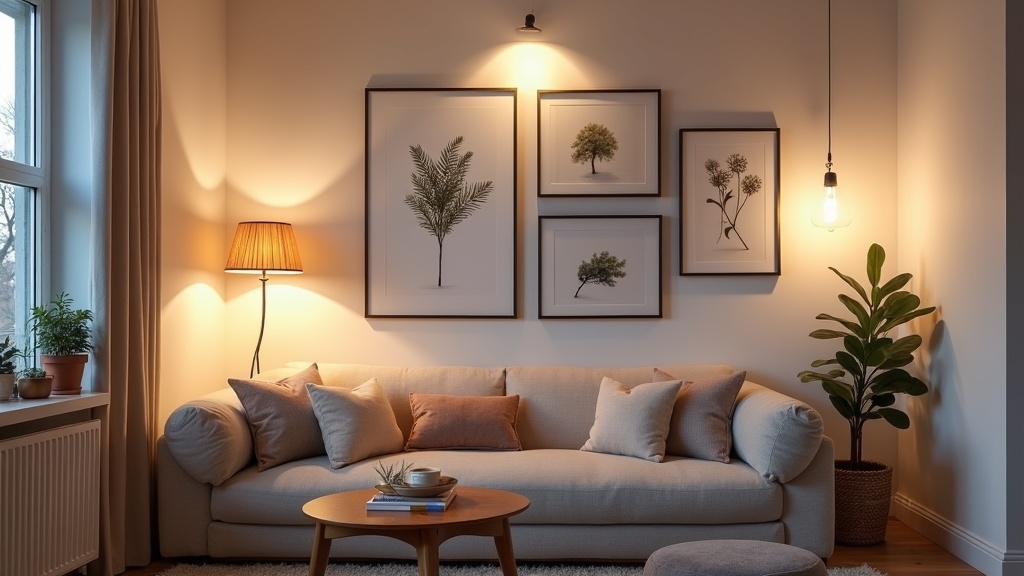
A gallery wall can hold beautiful work and still feel flat. A shelf can be thoughtfully styled and still look like furniture. What changes everything is light, placed with intention, at the right angle, in the right warmth.
Accent lighting for gallery walls and shelving is not about brightness. It is about presence. Done well, you stop noticing the fixture entirely. You only notice how good the room feels.
Key points at a glance
- 2700K is almost always the right color temperature for accent lighting at home.
- Plug-in and battery options now rival hardwired fixtures in quality, with zero rewiring needed.
- The ideal angle for lighting art is 30 degrees from vertical, to minimize glare.
- LED strip lights work beautifully for shelf ambiance but need a warm tone and a dimmer to avoid feeling clinical.
- The most common mistake is overlighting. One focused beam beats three competing ones.
- Picture lights should extend at least two-thirds the width of the frame they illuminate.
What good accent lighting gives you
Why Accent Lighting Changes How a Room Feels
Overhead lighting illuminates a space. Accent lighting gives it depth. The difference is the difference between a room that functions and a room that you want to be in.
When you direct a warm beam at a painting or a shelf of objects, you create contrast. That contrast creates focus. The eye has somewhere to land, and the brain reads the room as considered, layered, alive.
This is why professional interior designers rarely rely on ceiling fixtures alone. Light placed low, near, and directionally does more for the atmosphere of a room than almost any other single decision.
Gallery Walls: What Kind of Light Actually Works
A gallery wall is a collection. Lighting it well means honoring that variety, not flattening it with a single overhead spot.
Picture lights for individual frames
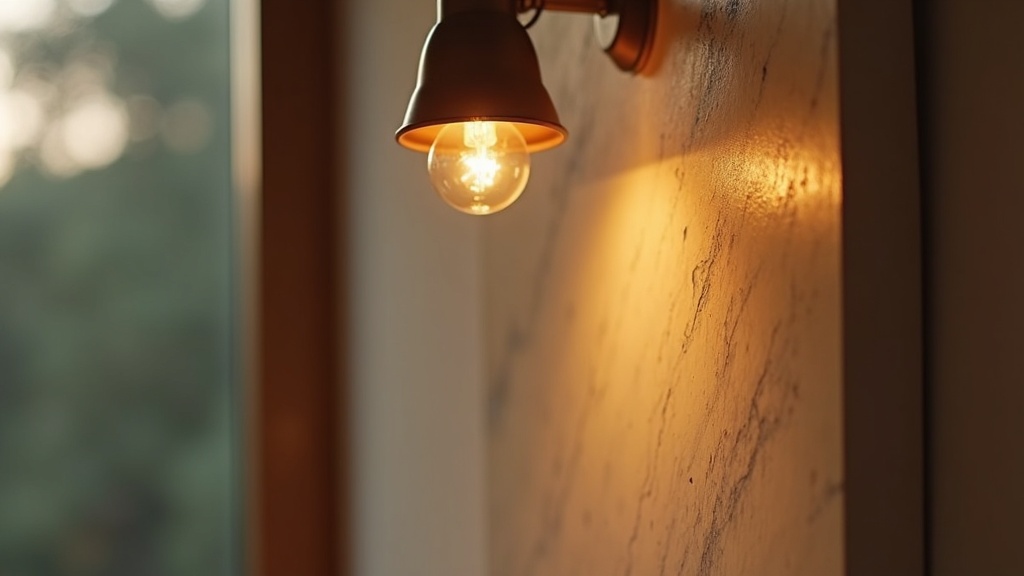
A picture light for a gallery wall works best when it sits above the anchor piece, usually the largest or most central frame. It draws the eye in and lets the surrounding pieces radiate from that focal point.
For smaller frames, wall-mounted LED spotlights on a low-voltage track system give you flexibility. You can aim each head independently and adjust as the wall evolves.
What about a full wall of prints?
If your gallery wall spans a large area, a single picture light will not reach the edges. Consider two offset picture lights, or a small track mounted discreetly above the arrangement. The goal is even coverage with soft variation, not a uniform wash.
Did you know?
Museums and galleries typically set their accent lighting at a 30-degree angle from the vertical surface of the artwork. This angle maximizes the visibility of texture and brushwork while keeping glare off glazed or varnished surfaces.
Shelving: Directional Light vs. Ambient Glow
Shelves have two lighting personalities, and understanding which one you need saves a lot of second-guessing.
Directional light
Use this when the shelf holds objects worth looking at. A small puck light or adjustable spotlight mounted at the shelf above points downward and picks out texture, form, and color. It creates shadow and depth. It makes a ceramic vase look like sculpture.
Ambient glow
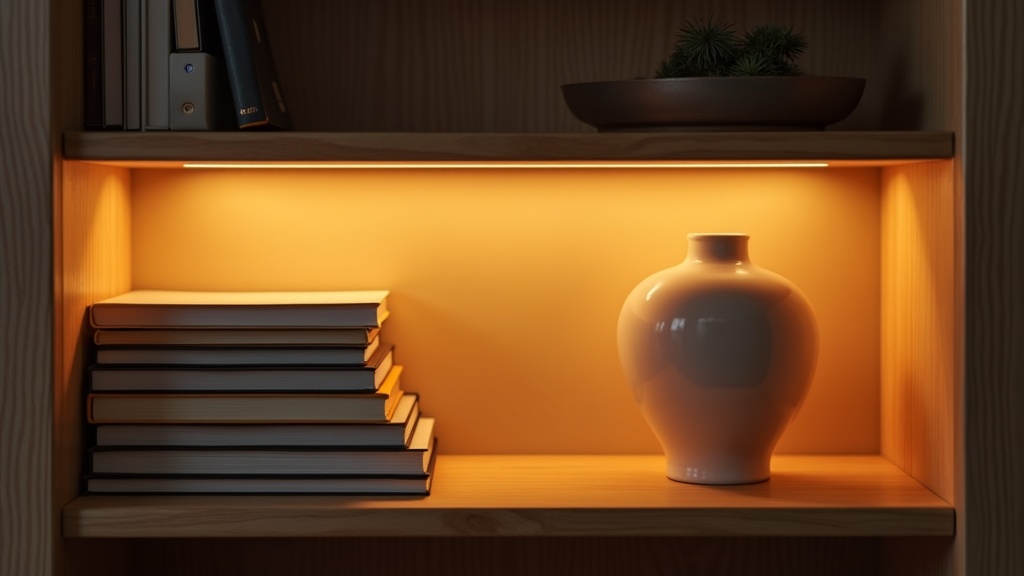
LED strip lights along the underside or back of a shelf produce a soft, diffused glow rather than a focused beam. This works well for shelf lighting ideas in a living room where the goal is mood rather than object display. Think books, baskets, soft objects.
The two approaches can coexist. A back-lit shelf with one directional spotlight on a key object is a classic combination that never looks overdone.
Hardwired vs. Plug-in vs. Battery: Choosing Without Overthinking
Most people do not need to rewire anything. The options available today are genuinely good.
- Hardwired: The cleanest look. No cord visible, no charging needed. Worth it if you are already renovating or if the fixture will never move.
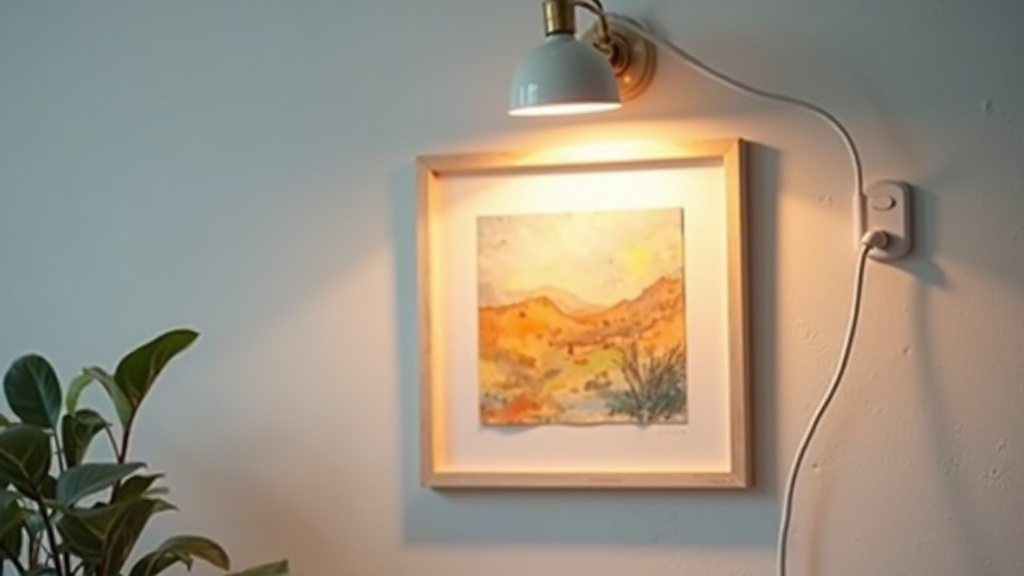
- Plug-in accent lighting with no rewiring: The most practical choice for most rooms. Modern plug-in picture lights use slim cords that run behind the frame or down the wall discreetly. Quality has improved significantly in the last five years.
- Battery-operated picture lights: Ideal for renters, for art hung on tricky walls, or for rooms where a cord would be visible. Rechargeable models now last weeks between charges. The convenience is real.
| Type | Best for | Limitations | Typical cost range |
|---|---|---|---|
| Hardwired | Permanent installations, renovations | Requires electrician, no flexibility | $80 to $300+ installed |
| Plug-in picture light | Most homeowners, renters with outlets nearby | Cord management needed | $30 to $120 |
| Battery-operated picture light | Renters, awkward wall positions | Needs recharging every few weeks | $25 to $90 |
| LED strip lights (plug-in) | Shelf ambiance, back-lighting | Not ideal for art illumination | $15 to $60 per shelf |
| Low-voltage track (plug-in) | Large gallery walls, flexible arrangements | More visible hardware | $60 to $180 |
Color Temperature and Why 2700K Is Usually the Right Answer
Color temperature is measured in Kelvin. The lower the number, the warmer and more amber the light. The higher the number, the cooler and bluer it reads.
For warm accent lighting in a bedroom or living room, 2700K sits in exactly the right place. It reads like candlelight's composed, confident sibling. Skin looks warm, wood looks rich, art looks considered.
3000K is acceptable and slightly crisper. Anything above 3500K starts to feel like a workspace. For how to light artwork at home, 2700K is the standard that museums and galleries lean toward for residential-scale displays.
Did you know?
The CRI (Color Rendering Index) of a bulb matters as much as its Kelvin rating when lighting art. A CRI of 90 or above ensures that the pigments in a painting or print appear close to how they look in natural daylight. Many cheap LED strips have CRIs below 80, which visibly dulls colors.
Placement: The Angles That Make Art Look Its Best
The 30-degree rule is your baseline. Mount the light source so the beam hits the center of the artwork at roughly a 30-degree angle from the wall's vertical plane.
Picture lights
Mount the fixture so the bottom of the bar sits 3 to 5 inches above the top of the frame. This keeps the light aimed at the artwork rather than the wall above it.
Track spots and adjustable heads
Stand back and look at where the bright spot actually falls. Adjust until the hotspot sits in the center of the piece. The edge fall-off should be gradual, not abrupt.
LED strips on shelves
Mount strips at the back of the shelf rather than the front edge. Back-mounted strips create a halo behind objects. Front-mounted strips often create glare at eye level and look unfinished.
Common Mistakes (and the Simple Fixes)
- Too many light sources competing: One well-placed beam is better than three weak ones. Start with less.
- Cool white LED strips: A 6500K strip on a shelf looks like a refrigerator. Swap for 2700K warm white. It costs the same and changes everything.
- Light that misses the art: If the hotspot lands on the wall above or below the frame, the picture light is mounted at the wrong height. Move it down 2 inches and check again.
- No dimmer: Accent lighting without a dimmer is accent lighting at the mercy of your mood. Most plug-in options work with an inline dimmer, usually under ten dollars.
- Picture light too narrow for the frame: A fixture that spans only half the artwork leaves the edges dark. Aim for a light bar that is at least two-thirds the width of the frame.
A Few Pieces Worth Considering
These are not sponsored recommendations. They are the types of products that consistently perform well across the criteria above.
- Brass plug-in picture lights with a rocker switch: The switch on the cord means no hunting for an outlet timer. Brass ages well and reads warm against most wall colors.
- USB-rechargeable battery picture lights: Look for ones with a 300-lumen minimum output and a stated CRI above 90. Run time of 50 to 80 hours per charge is realistic for quality models.
- LED strip lights with a warm-white COB (chip-on-board) design: COB strips have no visible individual LED dots, so the light appears as a smooth continuous line rather than a dotted glow. This matters enormously at close range on a shelf.
- Low-profile magnetic track systems: Several European brands now make surface-mounted magnetic tracks that accept small adjustable spots. No cutting, no wiring, just a plug. They suit gallery walls with four or more pieces very well.
Light placed right does more for a room than any renovation. The fixtures above are tools. What matters is where and how you use them. Start with one piece of art, one warm beam, and see how the room shifts. Then adjust from there. Lagom: not too much, not too little.


