
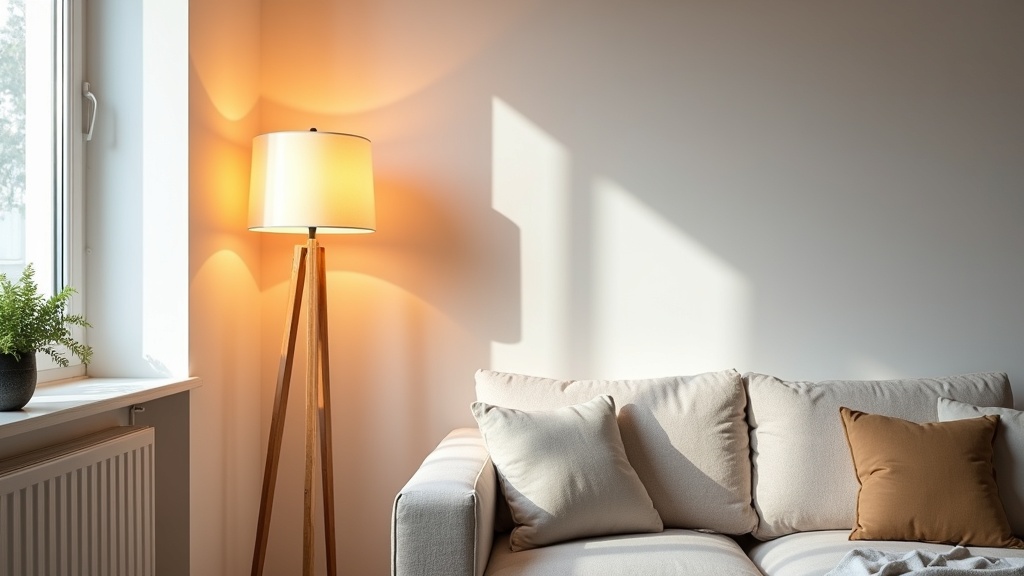
Your apartment hasn't changed size. But depending on how you light it, it can feel like a generous studio or a storage unit you happen to sleep in. That gap, entirely invisible on a floor plan, is caused by lighting choices that most people never question.
These are the mistakes worth knowing. Each one is fixable without a renovation, without a landlord's permission, and without spending much at all.
Key points at a glance
- A single overhead light is the fastest way to make a room feel small and flat
- Cool white bulbs (above 4000K) visually compress walls and kill warmth
- Unlit corners shrink the perceived size of any room significantly
- Lamp scale matters: undersized lamps disappear and leave rooms looking unbalanced
- Blocking natural light, even partially, removes the room's biggest spatial asset
- Layering three types of light (ambient, task, accent) transforms how a space feels
What good lighting actually gives you
Why Lighting Shapes Space More Than Paint or Furniture
Paint changes color. Furniture changes function. Light changes how the brain reads the boundaries of a room. It controls shadow, depth, and perceived height all at once.
Poorly lit rooms feel smaller because the eye can't find the edges. When corners are dark and the ceiling is the only light source, the walls seem to press inward. It isn't imagination. It's visual perception, and it's completely correctable.
Mistake 1: One Overhead Light Doing All the Work
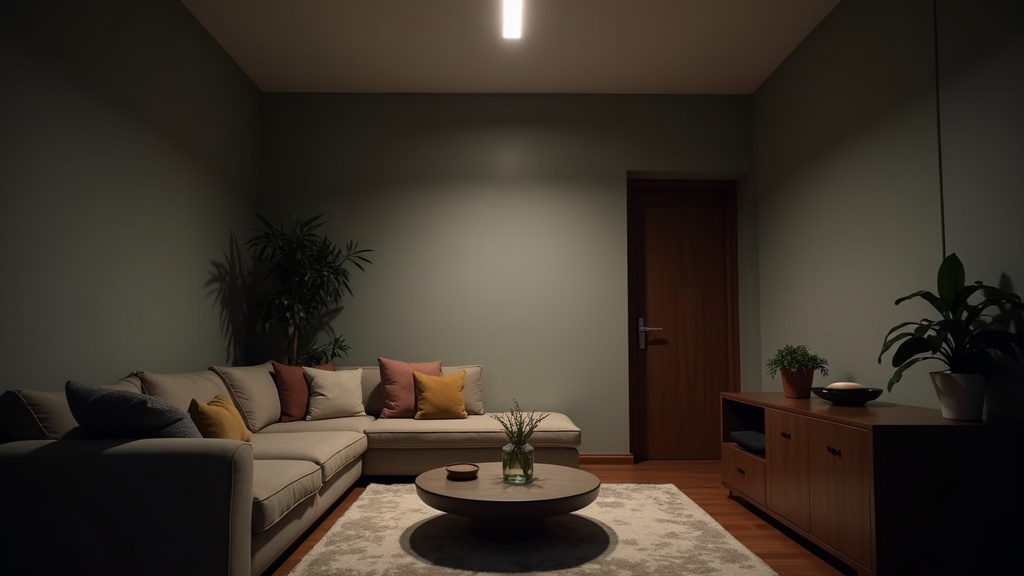
This is the most common mistake in small apartments, and the most damaging. A single ceiling fixture floods the room with flat, directionless light. Every surface looks equally bright. There's no depth, no shadow play, no sense of zones.
Flat light reads as small light. When there's no contrast between near and far, the room compresses. Adding even one floor lamp or table lamp immediately creates layers, and layers create the illusion of space.
Mistake 2: Cool White Bulbs That Flatten the Room
Bulb temperature is measured in Kelvin. Most standard apartment fixtures come fitted with whatever the building manager ordered in bulk, often 5000K or 6000K daylight bulbs. These make rooms feel clinical. They're fine in a hospital. In a home, they strip warmth from every surface.
Warm light (2700K to 3000K) makes walls feel closer in a good way. It creates depth and comfort. The room doesn't look brighter, it looks inhabited. That distinction matters enormously in a small space.
Did you know?
Research in environmental psychology shows that warm-toned lighting (around 2700K) consistently makes people rate a room as larger, more comfortable, and more welcoming than the same room lit with cool white bulbs at the same lumen output. The color of light, not just its brightness, shapes spatial perception.
Mistake 3: Ignoring the Corners (Where Space Goes to Die)
Dark corners are where small apartments surrender their square footage. The eye stops at darkness. When a corner disappears into shadow, the brain registers it as a boundary, a wall that is closer than it actually is.
Place a floor lamp or a small table lamp in a neglected corner and something shifts immediately. The room doesn't just feel brighter, it feels wider. The light pushes the perceived edge of the room outward.
Mistake 4: Lamps That Are Too Small for the Furniture Around Them
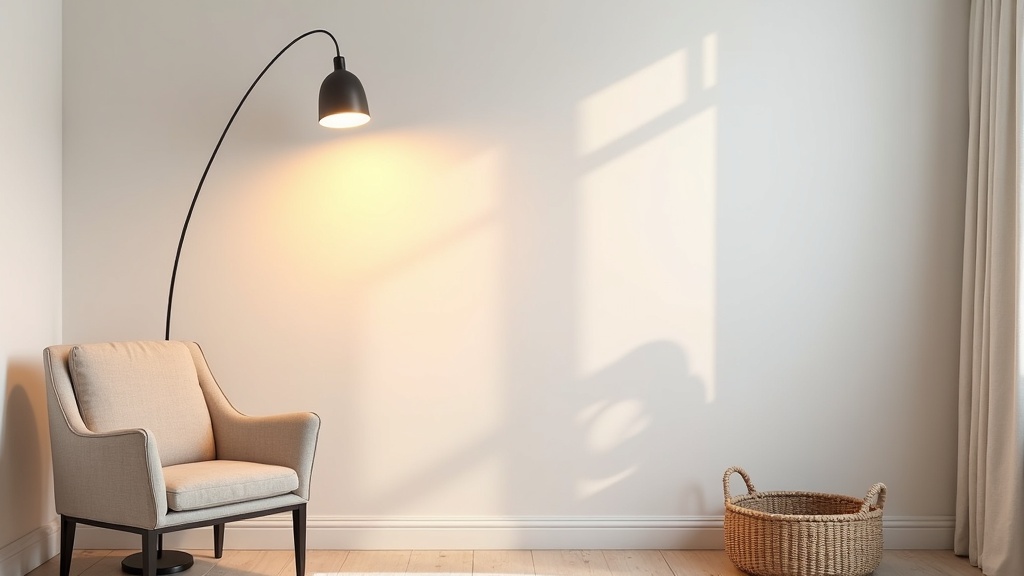
A lamp that's too short beside a sofa looks apologetic. A tiny shade perched on a side table next to a large armchair creates visual imbalance, and that imbalance makes everything feel cluttered and cramped.
Scale is proportion, and proportion creates calm. A floor lamp in a small living room should stand roughly at shoulder height when you're seated. A table lamp shade should sit at eye level when you're next to it. These aren't rigid rules, they're starting points for a room that feels considered.
Mistake 5: Blocking Natural Light Without Realizing It
Heavy curtains pooled across a window. A bookshelf placed too close to the glass. A sofa pushed against the sill. These choices cut off the most powerful spatial tool any small apartment has.
Natural light makes a room feel boundless because it doesn't originate from inside it. Even diffused northern light through a linen curtain is worth protecting. Swap thick drapes for sheer panels. Move furniture six inches from the window. The difference is immediate.
Did you know?
Hanging curtains close to the ceiling and extending the rod 20 to 30 cm beyond each side of the window frame makes a standard window appear significantly larger. This is one of the oldest visual tricks in interior design, and it costs only a longer curtain rod.
Mistake 6: No Dimmer, No Control Over How the Room Feels
A room with no dimmer has one mood. That mood is whatever the bulb decided. For small apartments that serve as living room, dining room, and workspace all at once, a fixed light level is a daily frustration.
Smart plugs with dimming function or plug-in lamp dimmers cost under 20 euros and change everything. Low light in the evening makes a small room feel intimate rather than cramped. This is the lagom principle applied directly: not too much light, not too little. Just what the moment needs.
The 3-Layer Rule: A Simple Fix for Any Small Room
Every well-lit room, regardless of size, uses three types of light working together. This isn't complicated. It's a framework.
- Ambient light: the general background light, usually a ceiling fixture or pendant
- Task light: focused light where you actually do things, a reading lamp, a desk lamp, under-cabinet kitchen lighting
- Accent light: light that creates atmosphere, a lamp in a corner, a small LED strip behind a shelf, a candle
In a small apartment, the temptation is to skip layers two and three because the space feels too small to justify them. The opposite is true. Layers create depth, and depth creates space.
| Light Type | Purpose | Best Source for Small Apartments |
|---|---|---|
| Ambient | General illumination, background level | Ceiling pendant or semi-flush fixture at 2700K |
| Task | Reading, cooking, working | Articulated desk lamp or floor reading lamp |
| Accent | Depth, mood, visual interest | Corner floor lamp, shelf LEDs, candles |
| Natural | Spaciousness, energy, rhythm | Unobstructed windows with sheer linen panels |
Small Changes, Immediate Difference
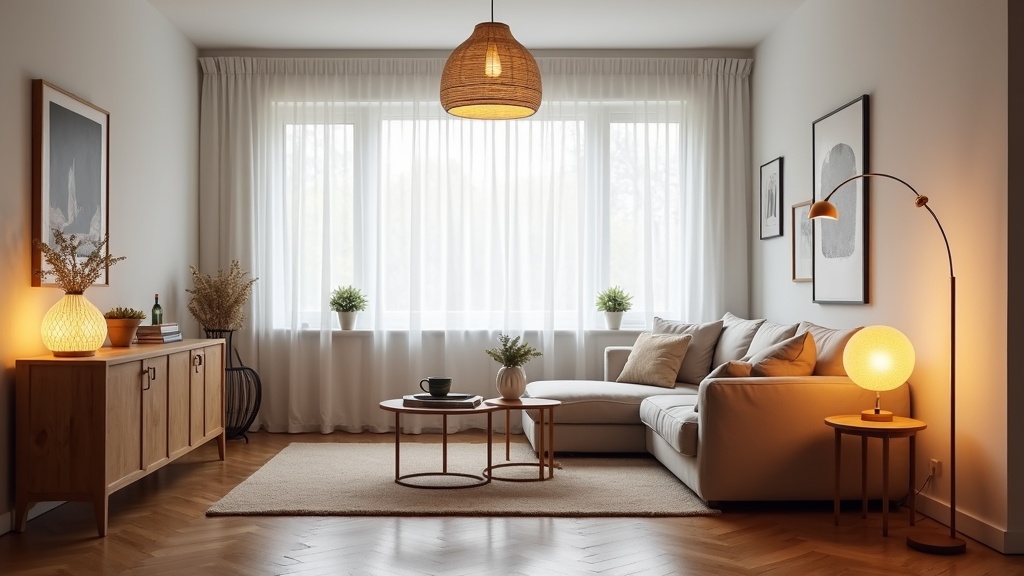
You don't need to rework the whole apartment. Start with one correction and notice what shifts.
- Replace one cool bulb with a 2700K warm equivalent this week
- Move a lamp into the darkest corner of your main room
- Swap heavy curtains for a sheer panel, or simply pull them fully open during daylight hours
- Add a plug-in dimmer to your main lamp and try living at 60% brightness after sunset
- Place a floor lamp behind or beside the sofa, not just overhead
Good lighting doesn't announce itself. It settles into the room and changes how it feels. The goal isn't a brighter apartment, it's a deeper one. More layers, more shadow, more life in the corners. That's what makes a small space feel like somewhere you actually want to be.


