
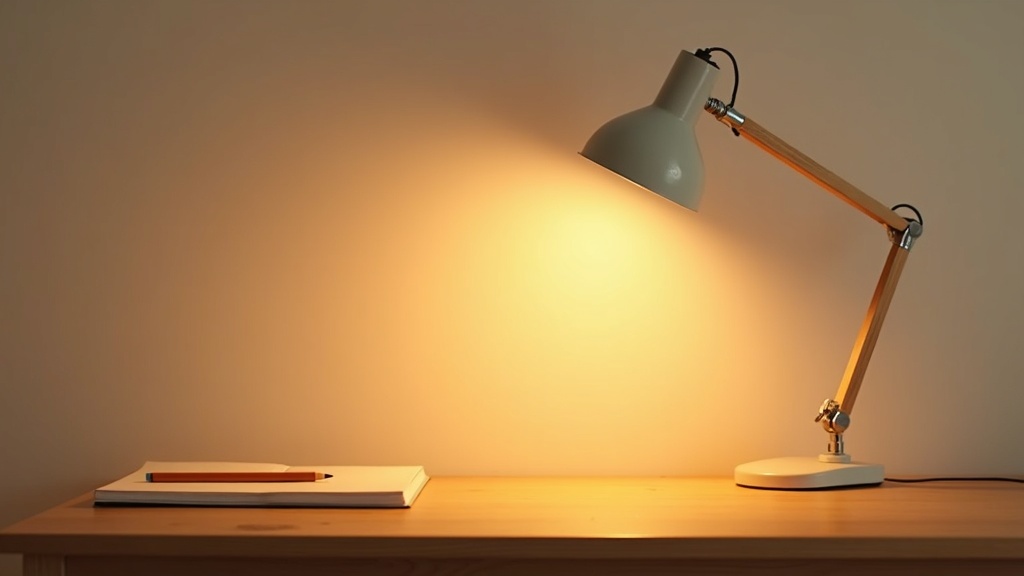
Your desk lamp is doing more than you think. It shapes your mood, your posture, your ability to focus, and how long you last at your desk before your eyes start pulling you away from the screen.
This desk lamp guide for home offices that feel calm is about getting the light right, once, so you stop noticing it. That is exactly when it starts working.
Key points at a glance
- Color temperature between 2700K and 3000K creates the warmest, most restful working light
- Warm light for home office use reduces evening eye strain without sacrificing focus
- Lamp placement on the wrong side causes shadow fatigue, a common but avoidable mistake
- Layered lighting, not a single overhead bulb, is what makes a room feel genuinely calm
- The 5-7 rule gives you a simple, actionable brightness target for any desk setup
- LED desk lamps for home office spaces now offer excellent warm-tone options at every price point
What good desk lighting actually gives you
Why Light Shapes How Your Office Feels (Not Just How It Looks)
Good lighting does not announce itself. It settles into the room and changes how you feel before you have named it.
Harsh overhead fluorescents create low-level tension. A single warm lamp on a wooden desk creates something closer to ease. The difference is not decorative. It is physiological. Your nervous system reads light before your eyes do.
A calm home office is not built with furniture. It is built with light.
The One Number That Matters Most: Color Temperature Explained
Color temperature is measured in Kelvin. The lower the number, the warmer and more amber the light. The higher the number, the cooler and bluer it becomes.
- 2700K: very warm, close to candlelight, deeply relaxing
- 3000K: warm white, the sweet spot for cozy home office lighting
- 4000K: neutral white, clinical but focused
- 5000K+: daylight or cool white, best for detail work only
For a home office that feels calm, stay between 2700K and 3000K. That range keeps energy stable without pushing the room into sterile territory.
Did you know?
Blue-enriched light above 5000K suppresses melatonin production significantly. A 2019 study published in PLOS ONE found that even low-level blue light exposure in the two hours before sleep measurably delays sleep onset. Switching your desk lamp to a warm 2700K bulb after 6pm is one of the simplest sleep-hygiene adjustments you can make.
Warm vs. Cool Light: Which One Actually Helps You Focus?
The honest answer: it depends on the task.
Cool light (4000K and above) increases alertness and suits detail-heavy work like reading fine print or colour-matching. But it also raises cortisol slightly, which is useful for short sprints and exhausting over a full day.
Warm light for home office use at 3000K keeps you attentive without the edge. For writing, calls, reading, and thinking, that is usually the better fit. It is lagom: not too much, not too little.
The Layered Light Approach: Why One Lamp Is Never Enough
A single overhead bulb creates uniform, flat light. Nothing casts a shadow. Nothing anchors the eye. The room feels like a waiting room.
Layered lighting uses three types together:
- Ambient: the general room light, ceiling or floor lamp
- Task: your desk lamp, focused on the work surface
- Accent: a shelf light, a small lamp in a corner, something that softens the edges
Your desk lamp is the task layer. It should not carry the whole room. Let the other layers do their part.
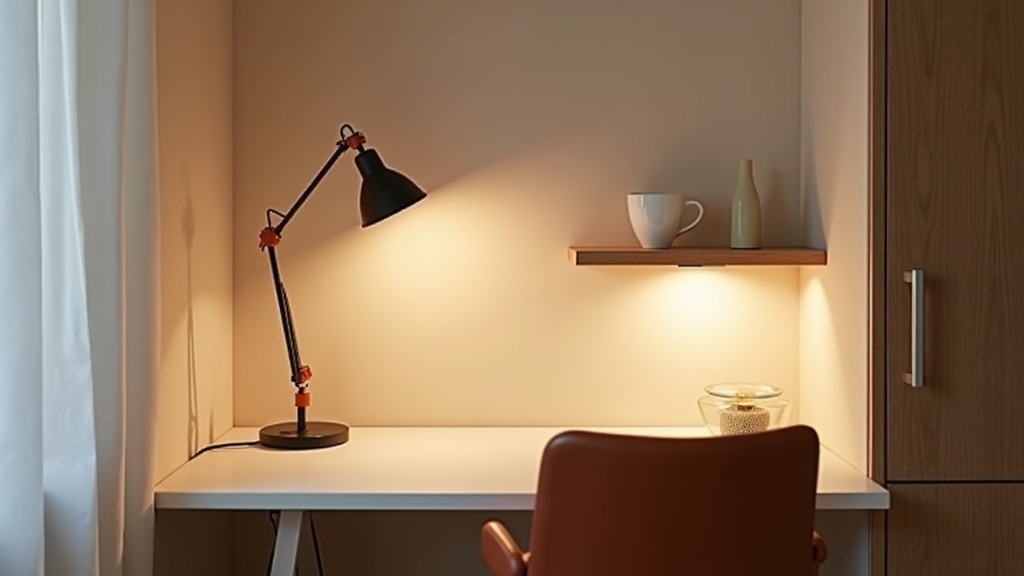
Desk Lamp Placement: Where You Put It Changes Everything
Placement is the most overlooked variable in any desk lamp guide for home offices. A perfect lamp in the wrong position still causes eye strain.
The basic rule
Place the lamp on the opposite side from your dominant hand. Right-handed: lamp on the left. Left-handed: lamp on the right. This stops your hand casting a shadow over your work.
Height and angle
The lamp head should sit 15 to 20 cm above the work surface and angle at roughly 30 degrees toward the page. Too high and the light spreads thin. Too close and glare bounces off bright paper directly into your eyes.
What to avoid
- Lamp positioned directly behind your screen (creates halo glare)
- Lamp aimed at a reflective monitor surface
- Placing the lamp directly in your sightline
Did you know?
The Illuminating Engineering Society recommends a minimum of 500 lux on a task surface for sustained reading and writing. Most single overhead ceiling fixtures deliver only 100 to 200 lux at desk height. A quality desk lamp placed correctly easily makes up the difference on its own.
What to Look for When Buying a Desk Lamp for a Calm Space
The market is full of lamps. Most of them are not worth the space they take. Here is what actually matters.
- Dimmer: non-negotiable. Your needs change between morning calls and late-afternoon writing.
- Color temperature control: useful, not essential. If you can only choose one, get a fixed warm 3000K.
- CRI above 90: Color Rendering Index measures how accurately a light source shows real colors. Below 80, everything looks slightly off.
- No visible flicker: cheap LED drivers flicker at frequencies the eye cannot consciously detect but the brain registers. Ask for PWM-free or high-frequency drivers.
- Material: matte metal, solid ceramic, or natural wood reads as calm. Glossy plastic catches the light and draws the eye unnecessarily.
A Scandinavian desk lamp aesthetic, clean form, honest material, no excess, is a reliable starting point precisely because those design traditions treat restraint as a feature, not a compromise.
Five Desk Lamps Worth Considering (Across Every Budget)
| Lamp | Best for | Key feature | Budget range |
|---|---|---|---|
| BenQ e-Reading Lamp | Screen-heavy setups | Wide, even spread, no screen glare | Mid-range |
| IKEA Ranarp | Minimal, warm aesthetics | Metal arm, adjustable head, pairs with E14 warm bulb | Budget |
| Anglepoise Original 1227 | Long-term use, heirloom quality | British classic, precise directional control | Premium |
| TaoTronics TT-DL13 | Flexible daily use | 5 color temps, 7 brightness levels, USB charging | Budget |
| HAY Matin Table Lamp | Scandinavian calm, accent light | Porcelain shade, soft diffused warm glow | Mid-range |
The 5-7 Lighting Rule and What It Means for Your Desk Setup
The 5-7 rule comes from ergonomic lighting research: the brightness ratio between your task surface and the surrounding room should stay between 5:1 and 7:1. Too far outside that range and your pupils are constantly adjusting, which is what causes that slow, grinding fatigue by mid-afternoon.
In practice: if your desk lamp is on, your room should not be completely dark. Keep at least one ambient source running at low level. A floor lamp behind you on a dimmer, set to about 20 percent, is usually enough.
Small Adjustments That Make a Noticeable Difference Today
You do not need to replace your lamp. Start with what you have.
- Swap to a 2700K bulb in your current lamp. Cost: under £5. Impact: immediate.
- Move the lamp to the other side of your desk if shadows are falling across your notebook or keyboard.
- Add a small plug-in lamp on a shelf or windowsill behind your desk as a second warm source. This alone softens the entire room.
- Turn on your desk lamp before you sit down. Let the room settle into its light before you start working. It is a small ritual, but it signals to your brain that focus is coming.
- Lower brightness by 30 percent after 5pm. Your eyes will thank you. So will your sleep.
Light placed right does more for a room than any renovation. These are five-minute changes. None of them cost much. All of them matter.


