
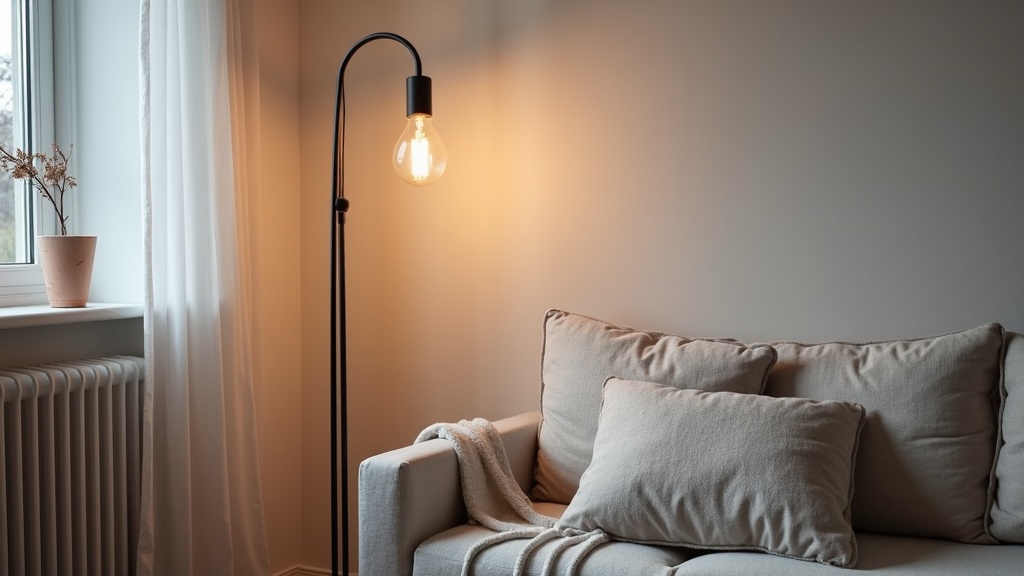
A small living room doesn't need less furniture. It needs smarter light. The right arched floor lamp arcs over your sofa, throws a warm pool of light exactly where you sit, and takes up roughly the same footprint as a dinner plate.
Most people think floor lamps eat space. An arched lamp actually does the opposite: it borrows vertical room rather than floor room, and it gives a small space the layered warmth that overhead lights never can.
Key points at a glance
- An arched floor lamp uses minimal floor space while delivering focused, layered light over a seating area.
- Base footprint and arc reach matter more than height when choosing a lamp for a compact room.
- Slim bases and single-arc designs are the safest choices for rooms under 200 sq ft.
- Placement behind or beside the sofa, tucked into a corner, keeps the lamp present but unobtrusive.
- Arched lamps work in every style register: modern, vintage, brass, white. The finish sets the mood.
- A dimmer-compatible bulb turns one lamp into multiple lighting moods without adding any hardware.
Why this lamp type earns its place
Why an Arched Lamp Works Better in a Small Room Than You'd Expect
The logic is simple. A standard table lamp needs a surface. A wall sconce needs wiring. An arched floor lamp needs only a small patch of floor and a socket.
Its arc clears your furniture and delivers downward, focused light over the area where you actually sit. That's task lighting and ambient lighting at once, from a single object.
In a compact room, every piece has to earn its place. An arc lamp earns its twice over.
What to Look for Before You Buy: Height, Reach, and Base Footprint
Three numbers decide whether a lamp fits your room or fights it.
Total height
Most arched floor lamps stand between 180 and 210 cm. Stay under 190 cm if your ceilings are below 240 cm, or the proportions will feel crowded.
Arc reach
The horizontal distance from base to shade is usually 100 to 150 cm. Measure the depth of your sofa plus 20 cm. That's the minimum reach you need for the light to land correctly.
Base footprint
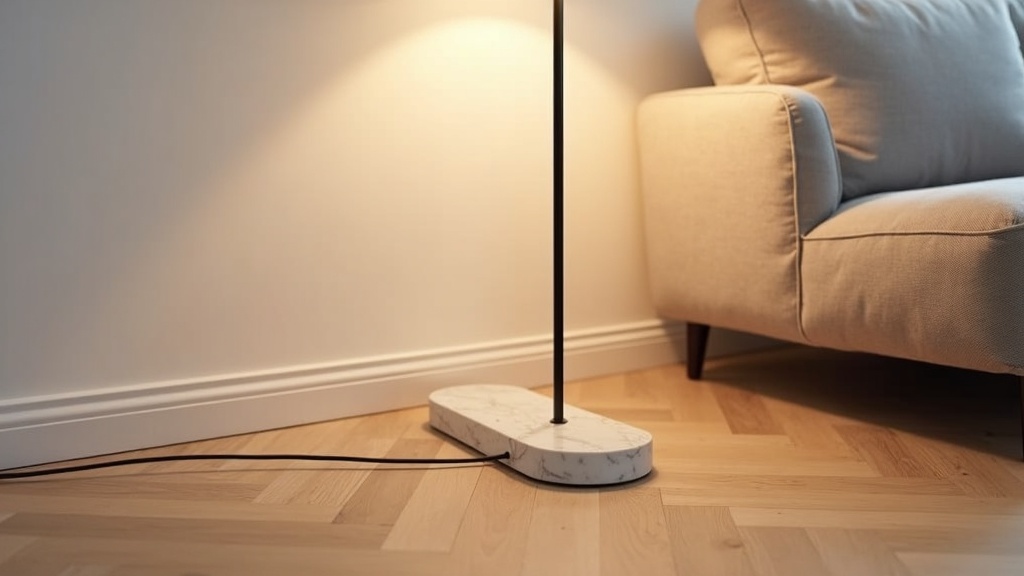
This is the number most people ignore. A heavy disc base can run 40 cm wide. A weighted knob base sits under 20 cm. In a small room, the base is everything.
- Disc or cross bases: stable, but spatially demanding
- Round knob or marble ball bases: the best choice for tight spaces
- Weighted column bases: tall, narrow, excellent for corners
Did you know?
The arc floor lamp as we know it was popularized in the 1960s by Italian designer Achille Castiglioni with the Arco lamp for Flos. Its marble base was deliberately heavy enough to anchor the lamp without wall fixings. The design is still in production today, essentially unchanged.
The Styles Worth Knowing: Modern, Vintage, Brass, and White Finishes
Finish is the fastest way to anchor a lamp to a room's feeling. Get it right and the lamp disappears into the space. Get it wrong and it fights everything around it.
| Finish | Best for | Pairs well with |
|---|---|---|
| Matte black | Modern, industrial, Japandi rooms | Linen, concrete, oak |
| Brushed brass | Warm, vintage, eclectic spaces | Velvet, terracotta, walnut |
| White or off-white | Bright, Scandinavian, minimal rooms | White walls, rattan, pale woods |
| Chrome or nickel | Contemporary, mid-century influenced | Glass, marble, clean lines |
| Natural wood pole | Organic, biophilic, boho | Plants, linen, woven textures |
A white arched floor lamp is the quietest option in a small room. It recedes visually and lets the light itself do the work. A brass lamp adds warmth and a touch of personality without demanding attention.
Are Arched Floor Lamps Still in Style? The Honest Answer
Yes, and for a very practical reason: the form follows function perfectly. The arc puts light where bodies are, not where the ceiling dictates.
The Flos Arco, launched in 1962, is still one of the most sought-after lamps on the market. That's not nostalgia. That's a design that keeps proving itself right.
Current versions in slim matte black or warm brass sit comfortably in Japandi, mid-century, and contemporary rooms alike. The arc lamp doesn't date because it doesn't chase trends. It solves a problem quietly.
How to Place an Arched Lamp in a Small Living Room Without It Dominating the Space
Placement is where most people go wrong. The lamp ends up floating in the middle of the room, blocking sightlines and feeling oversized.
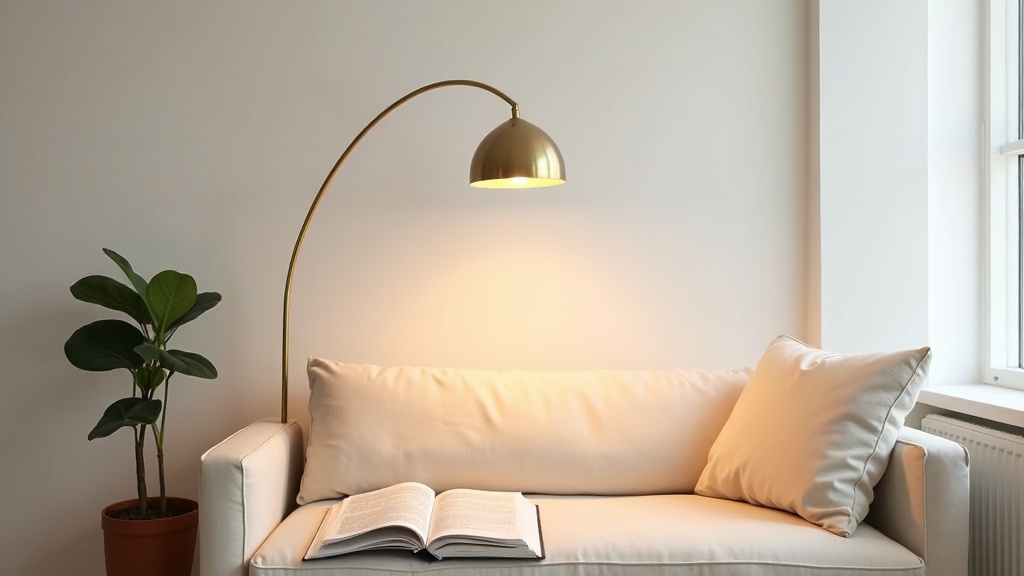
The rule is simple: base in the corner, arc over the action.
- Push the base into the back corner behind the sofa's end
- Let the arc extend forward so the shade sits roughly above the seat cushion
- Keep at least 30 cm between the shade and the top of anyone's head when seated
- Face the shade opening downward or at a slight angle toward the seat, not toward the room
The cord should run along the baseboard. A cord on the floor is a trip hazard and a visual mess in a small room. Take ten minutes to fix it.
Did you know?
Lighting designers recommend placing ambient light sources at or below eye level for seated occupants. Overhead lighting raises cortisol. Lateral and downward sources from lamps like arched floor lamps are associated with lower perceived stress in residential settings.
Are Arch Lamps Good for Living Rooms? Light Quality and Layering
An arched lamp works best as part of a layered scheme, not as a single source. Pair it with ceiling light for general illumination and use the arc lamp to create a reading or conversation zone.
For light quality, choose a bulb between 2700K and 3000K. That range is warm without being orange. It makes people look good, which makes a room feel good.
A dimmer-compatible LED in the 800 to 1000 lumen range is enough for a sofa area in a room under 25 square metres. More than that and the lamp starts competing with everything else.
The Best Arched Floor Lamps for Small Living Rooms Right Now
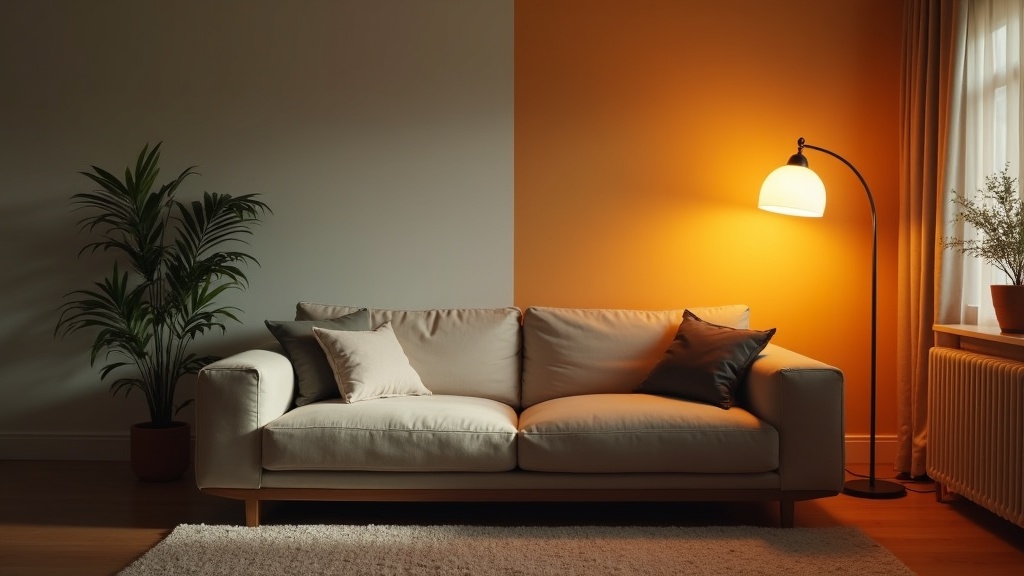
These are the types worth shortlisting, based on proportions that actually suit compact rooms:
- Single-arc, narrow pole, round knob base: the most space-efficient form. Works in any style.
- Adjustable-height arc lamp: lets you fine-tune the reach without moving the base. Practical in rooms where furniture changes.
- Rattan or fabric shade: softens the light and adds texture without adding visual bulk.
- Integrated USB or wireless charging base: removes the need for a side table entirely. Genuinely useful in a small room.
- Slim arc lamp in white with a drum shade: the most visually light option for a compact, neutral room.
Avoid multi-arm or triple-arc designs in rooms under 20 square metres. They're beautiful. They're also a lot, and a small room already has enough going on.
Common Mistakes to Avoid in a Compact Room
Getting the right lamp is only half of it. These are the mistakes that undermine even a good choice.
- Buying a base that's too wide. Measure before you order. A 40 cm disc base in a 3-metre-wide room is immediately visible from every angle.
- Positioning the base mid-room. It creates an obstacle course. Always anchor it against a wall or in a corner.
- Choosing a shade that's too large. A 50 cm dome shade on a slim lamp in a small room reads as cartoonish. Aim for 30 to 40 cm diameter maximum.
- Using a cool-white bulb. 4000K or above in a living room creates the atmosphere of a dentist's waiting area. Stay warm.
- Ignoring the cord. Manage it from day one. A loose cord makes a thoughtful room look careless.
Good lighting doesn't announce itself. It settles into the room and changes how it feels. The right arched floor lamp in the right position does exactly that: it earns its place and then quietly disappears into the life of the room.


