
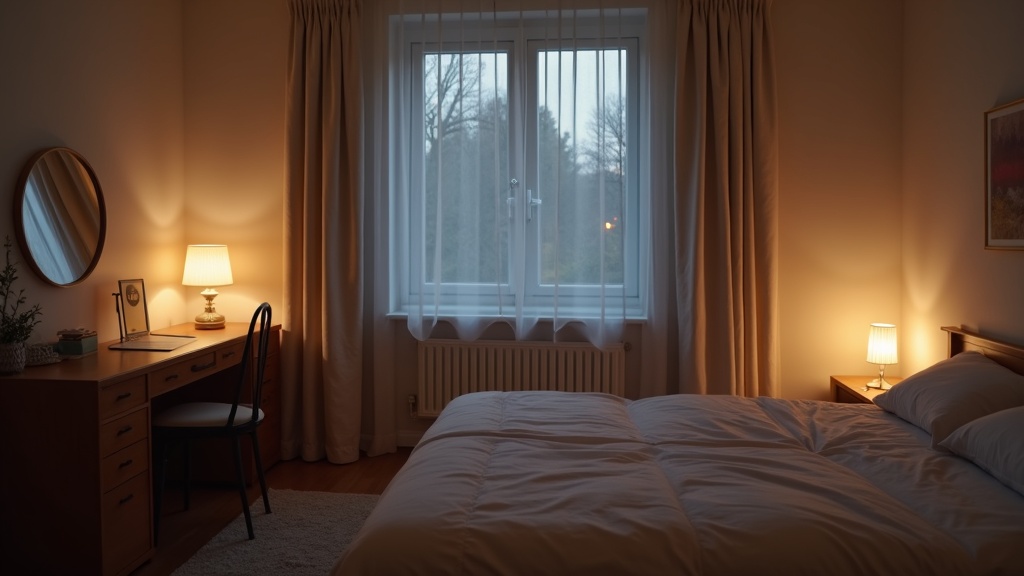
Your bedroom asks two things of you. Sometimes it needs you to slow down, soften, and let go. Other times it needs you to sit up, focus, and get something done. Most people set up the lighting for one of those states and wonder why the other feels off.
The fix is simpler than you might think. It starts with understanding that light is not just brightness. It is color, angle, and intensity working together to tell your body what time it is and how to feel.
Key points at a glance
- Warm light (2700, 3000 K) supports winding down; cool light (4000, 5000 K) supports focus.
- Color temperature directly affects melatonin production and your circadian rhythm.
- The 3-layer lighting rule gives you ambient, task, and accent control in one room.
- Smart bulbs and dimmers let you switch between relaxation and productivity modes instantly.
- Fixture placement matters as much as bulb choice, angle and position change everything.
- A few common habits (overhead-only lighting, wrong bulb color) quietly work against both goals.
What good bedroom lighting gives you
Why the Same Room Needs Two Different Kinds of Light
Most rooms serve one purpose. A bedroom serves several, sometimes within the same hour. You might wake up, work for ninety minutes at your desk, read for twenty, and then try to sleep. Each of those activities calls for a different quality of light.
Relaxation needs light that retreats. Productivity needs light that supports. The mistake most people make is treating both with the same overhead fixture set to the same brightness all day long.
The Science in Plain Terms: Color Temperature and Your Brain
Light color is measured in Kelvin (K). Lower numbers are warmer, more amber. Higher numbers are cooler, more blue-white. Your brain reads these signals the same way it reads daylight.
Blue-rich light suppresses melatonin. It tells your body it is midday. Warm amber light does the opposite: it signals dusk, and your body begins to prepare for sleep. This is your circadian rhythm responding to its oldest cue.
Did you know?
Research from Harvard Medical School found that blue light suppresses melatonin for roughly twice as long as green light, and shifts circadian rhythms by twice as many hours. Even low-level exposure in the two hours before sleep measurably delays sleep onset.
This is why bedroom lighting color temperature is not a decorating preference. It is a biological one.
Lighting for Relaxation: Warm, Low, and Indirect
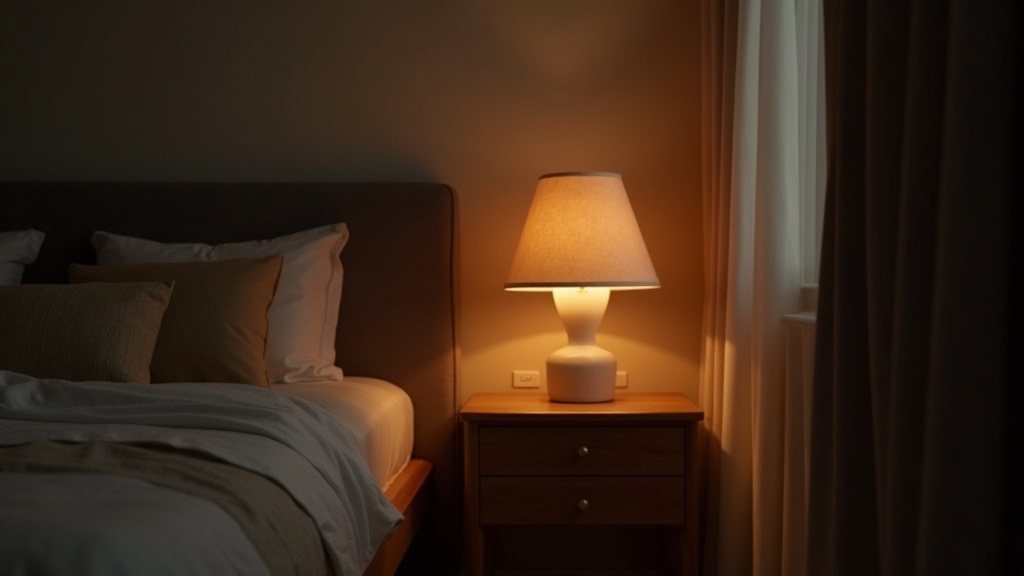
For winding down, the goal is light that feels like it belongs to the evening. Aim for 2700 K to 3000 K, positioned low and away from your direct line of sight.
Bedside lamps, floor lamps tucked into corners, and LED strip lights behind a headboard all work well. The key is keeping light below eye level and letting it bounce off walls rather than falling straight down onto you.
- Use bulbs at 2700 K or lower for dedicated sleep-prep zones
- Keep brightness between 100 and 300 lumens in the hour before bed
- Avoid ceiling fixtures entirely after 9 pm if you can
- Warm amber nightlights are better than nothing when you need to move around in the dark
Lighting for Productivity: Bright Enough, Placed Right
Task lighting for the bedroom is about precision, not flood. You do not need to light the whole room to work. You need to light the surface in front of you cleanly, without glare and without shadow falling across your work.
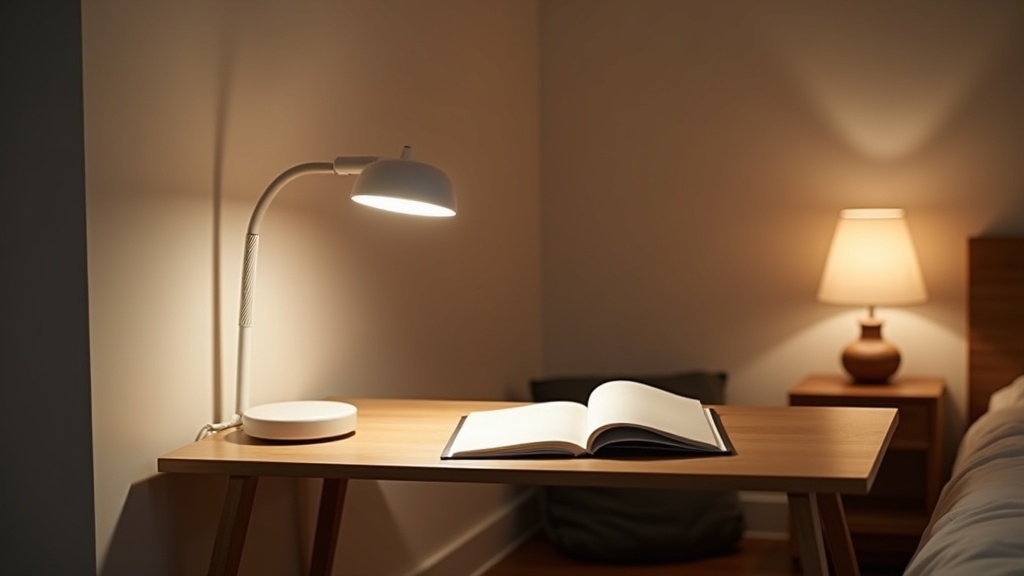
For a desk in the bedroom, aim for 4000 K to 5000 K at the task level. This range sits close to natural daylight and supports alertness without the harshness of higher temperatures.
Positioning a bedside lamp for reading and focus
If you read or work in bed, place the lamp so light falls over your shoulder from the side, not above or behind you. The bulb should not be visible from your reading angle. A directional shade makes this easier.
For desk work: position the light source to your non-dominant side at roughly 45 degrees. This minimizes hand shadows and keeps the screen glare down.
Did you know?
The Illuminating Engineering Society recommends a minimum of 500 lux on a work surface for sustained reading tasks. Most standard bedroom overhead fixtures produce around 100 to 200 lux at desk height, which is well below the threshold for comfortable focused work.
The 3-Layer Rule (and Why It Works in a Bedroom)
The 3 lighting rule for bedrooms divides your light sources into three types: ambient, task, and accent. Used together, they give you full control over the room's mood without any single fixture having to do everything.
| Layer | Purpose | Best for relaxation | Best for productivity |
|---|---|---|---|
| Ambient | General room illumination | Dimmed overhead or wall sconce, 2700 K | Overhead at medium brightness, 3500, 4000 K |
| Task | Focused illumination for a specific activity | Low bedside lamp for reading, 2700, 3000 K | Desk lamp or clamp light, 4000, 5000 K |
| Accent | Atmosphere and visual depth | Candles, LED strips behind headboard, 2200 K | Less relevant; keep minimal |
Layered bedroom lighting means you are never stuck. Turn off two layers, keep one: the room shifts entirely.
Switching Between Modes Without Rewiring Anything
You do not need a renovation. You need a few deliberate choices about what you plug in and how you control it.
Smart bulbs
Tunable white bulbs (also called color temperature adjustable) let you shift from 2700 K to 5000 K with an app or a voice command. Brands like Philips Hue, IKEA Trådfri, and Govee all offer reliable options at different price points. Set a warm scene for evenings and a cool daylight scene for working hours.
Dimmers
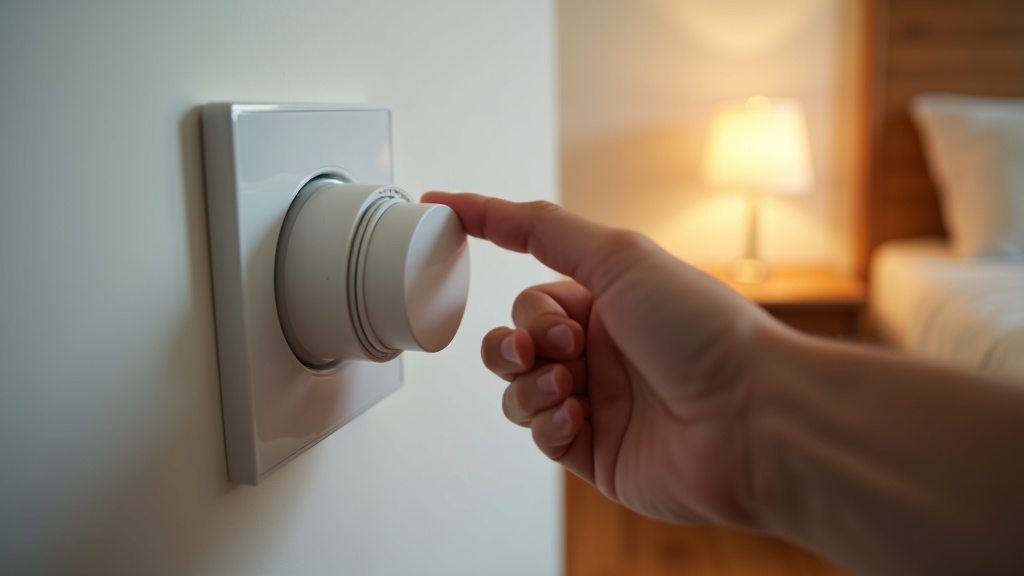
A dimmer switch is the cheapest single upgrade you can make. Even a warm 2700 K bulb at full brightness can feel harsh late at night. Dimmed to 30%, the same bulb becomes genuinely restful.
Separate circuits, simple habit
Plug your task light into one socket and your relaxation lamp into another. The switch between modes is then physical and immediate. No app needed, no setup.
The Fixtures and Bulbs Worth Choosing
Good pieces do not announce themselves. They fit the room and do their job quietly.
Best light bulbs for sleep
- Incandescent-style LED, 2700 K: the closest thing to candlelight in a standard socket
- Filament LED bulbs: warm, dimmable, and aesthetically calm
- Tunable white smart bulbs: the most flexible option if you want one bulb to serve both modes
Fixtures that earn their place
- Linen or paper shades: diffuse light gently; no harsh edges
- Adjustable arm desk lamps: direct light exactly where it needs to go
- Wall-mounted reading lights: free up the nightstand and keep the beam controlled
- LED strips behind the headboard: accent layer, zero glare, deeply effective for relaxation
Common Mistakes That Work Against Both Goals
These habits are worth noticing, because they are easy to fall into and quiet in their damage.
- Relying on a single overhead light: it flattens the room, creates harsh shadows, and cannot serve two modes
- Using a cool white bulb everywhere: 5000 K in a bedside lamp at 10 pm actively delays your sleep
- No dimmer at all: forces you into either full brightness or darkness, with nothing in between
- Screen light as a substitute: a phone screen as your only bedtime light is still blue-rich light, very close to your eyes
- Ignoring lamp height: a lamp that sits too low casts shadows upward; too high, it glares
- Matching all fixtures: a uniform look often means uniform function, and that is the problem
Your Practical Starting Point
You do not need to change everything at once. Start with two moves.
First: swap the bulb in your bedside lamp for a 2700 K dimmable LED. Use it only after 8 pm. Notice how the room feels within three nights.
Second: if you work in your bedroom, add a separate task light with a cooler bulb (4000, 5000 K) pointed at your work surface, not the room. Turn it off the moment you stop working.
That is the beginning of layered bedroom lighting. Warm vs cool bedroom lighting is not a design debate. It is a practical one, and the answer is always: both, used at the right time, in the right place. Just enough. Done well.


