
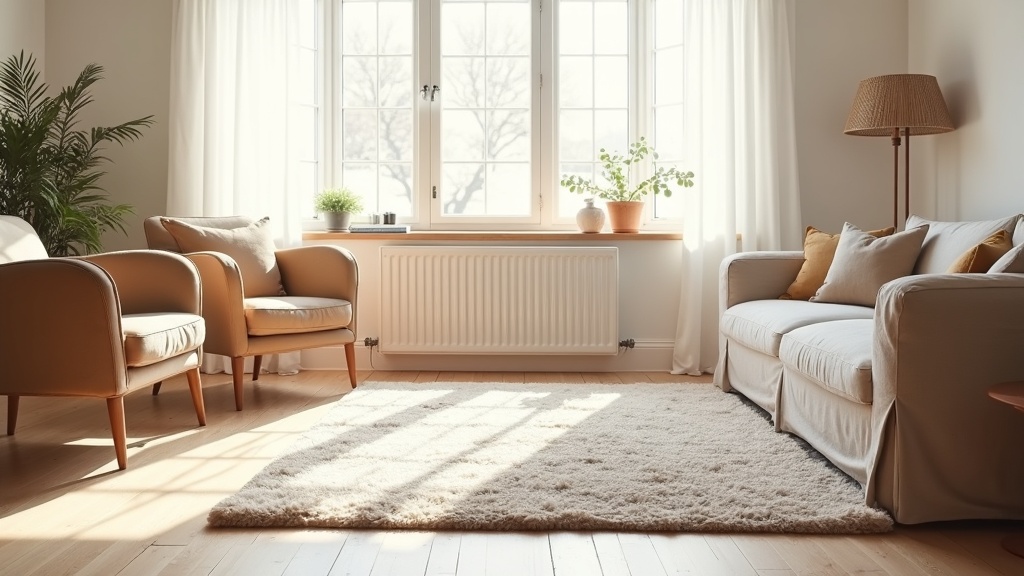
Move a rug six inches and the room changes. Not the rug, not the furniture. Just where one sits under the other. That relationship is what makes a living room feel settled or slightly off, without anyone being able to say exactly why.
This guide covers every common scenario: large rugs, sectionals, L-shaped sofas, rooms with a TV console, and the persistent question of whether the legs go on or off. Concrete rules, easy to apply.
Key points at a glance
- Rug placement matters more than rug size or pattern for how a room feels.
- Front legs on the rug is the most forgiving approach for most living rooms.
- An 8x10 rug works in most average living rooms; a 9x12 is right for larger or open-plan spaces.
- With a sectional, the rug should anchor the entire seating group, not just one side of it.
- Always leave 12 to 18 inches of bare floor between the rug edge and the wall.
- The TV console does not need to sit on the rug at all.
What good rug placement actually gives you
Why rug placement matters more than the rug itself
A beautiful rug placed badly looks like an afterthought. A simple rug placed exactly right disappears into the room, which is precisely what a rug should do.
Placement defines the zone. In an open-plan space, the rug is the only thing that tells the eye where the living area begins and ends. Get it wrong and the room never quite settles.
The core rule: where should a rug sit in a living room
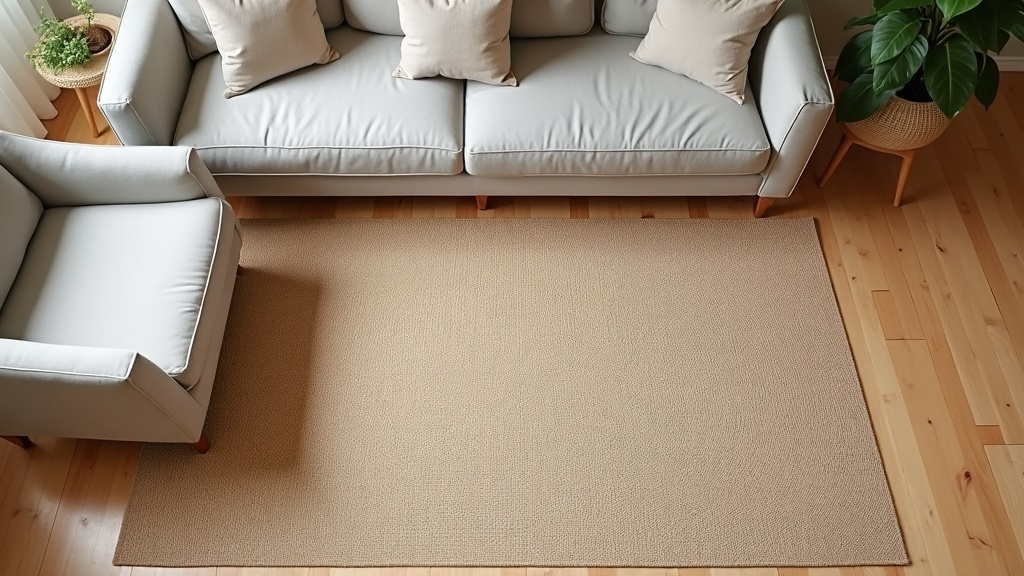
The rug should sit under the seating group, not beside it, not floating in the middle of the room on its own. Its job is to connect the furniture into a single composition.
As a starting point: the front legs of every seat in the arrangement should reach the rug. That single rule solves most placement problems immediately.
All legs on, front legs on, or no legs: which works best
These three approaches each produce a different result. None is universally wrong. But they suit different room sizes and intentions.
- All legs on the rug: creates the most grounded, formal look. Requires a large rug, typically 9x12 or bigger. The rug must extend at least 6 to 8 inches beyond the outer edge of every furniture leg.
- Front legs on the rug: the most practical and most commonly recommended option. Works well with an 8x10 rug in a standard room. It ties the seating group together without requiring a very large rug.
- No legs on the rug: only works if the rug is small and purely decorative, or if the furniture is intentionally pulled back. In most living rooms, this reads as a rug that is too small.
Did you know?
Interior designers consistently find that the most common rug mistake homeowners make is buying a rug that is too small, not too large. When in doubt between two sizes, always size up.
How to place an 8x10 or 9x12 rug in a living room
An 8x10 rug fits most living rooms between roughly 12x15 and 14x18 feet. Place it so the front legs of your sofa and chairs rest on it, with the rug centered on the seating arrangement rather than centered on the room.
A 9x12 rug suits larger rooms or open-plan layouts. It allows all legs on, which gives the space more weight and formality. Center it under the full furniture group.
In both cases, leave 12 to 18 inches of bare floor between the rug edge and the baseboard. Less than that and the rug looks squeezed. More and it starts to float.
Rug placement with a sectional or L-shaped couch
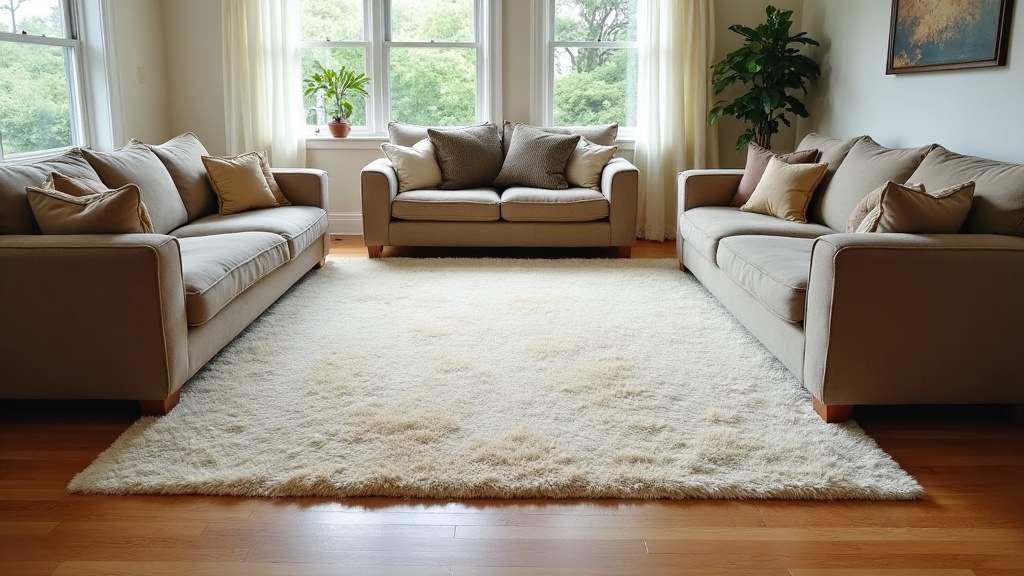
A sectional is one piece of furniture, and the rug should treat it that way. The rug needs to anchor the entire footprint of the sectional, not just the longer side.
For a standard sectional
Place the rug so the front legs of both the main sofa section and the chaise rest on it. The rug should extend about 6 inches beyond the corner of the sectional on each side.
For an L-shaped couch
Rug placement with an L-shaped couch follows the same logic. The inner corner of the L is usually where a coffee table sits. Center the rug on that coffee table, then check that both arms of the L have their front legs making contact with the rug.
A common mistake here: placing the rug only under the longer section and leaving the shorter arm floating. The room reads as unfinished, even if no one can explain why.
Did you know?
For L-shaped sectionals, designers often recommend a square rug rather than a rectangular one. A 9x9 or 10x10 fits the symmetry of the corner arrangement better than a long narrow rectangle.
Rug placement when there is a TV console in the room
The TV console sits against the wall. The seating group faces it. These are two separate zones, and the rug belongs to the seating zone, not to the TV wall.
The rug should not extend to the TV console. Leave the floor bare between the front edge of the rug and the console. This negative space actually makes the room feel more intentional, not less.
If the console has a low bench or media stand in front of it, the rug edge should stop well before it. Roughly 12 to 24 inches of bare floor between the rug and the console is ideal in most rooms.
The 2/3 rule and other sizing shortcuts worth knowing
The 2/3 rule: a rug should cover roughly two-thirds of the seating area's floor space. It is a quick visual check, not a precise measurement, but it works remarkably often.
| Room size | Recommended rug size | Best placement approach |
|---|---|---|
| Up to 12x14 ft | 5x8 or 6x9 | Front legs on rug only |
| 12x15 to 14x18 ft | 8x10 | Front legs on, or all legs on for a small group |
| 15x18 to 18x20 ft | 9x12 | All legs on |
| Open-plan or 20 ft+ | 10x14 or larger | All legs on, rug defines the zone |
| L-shaped sectional, any room | 9x9 square or 9x12 | Front legs of all sections on rug |
Another shortcut: tape out the rug size on the floor with painter's tape before you buy. Spend five minutes with it. You will know immediately if it is right.
Common mistakes that make a room feel off
- Rug too small: looks like a bath mat under the coffee table. The seating group floats, disconnected.
- Rug pushed against the wall: removes the border of bare floor that gives the room breathing room.
- Rug not centered: even a few inches off-center creates a tension the eye keeps returning to.
- Pattern orientation wrong: on a rectangular rug, the longer side should run parallel to the longer side of the sofa.
- No rug pad: a rug without a pad shifts, buckles, and wears unevenly. It also feels thinner underfoot than it should.
A simple checklist before you buy or move a rug
Run through this before anything is delivered or rearranged. It takes two minutes and saves a lot of frustration.
- Tape the rug dimensions on the floor. Walk around it. Sit in your usual seat and look down.
- Check that the front legs of every seat in the arrangement will reach the rug.
- Measure the gap from each edge of the taped area to the nearest wall. It should be 12 to 18 inches all around.
- Confirm the rug is centered on the seating group, not on the room.
- If you have a sectional, make sure the tape extends under both sections of the L.
- Verify the rug does not extend toward the TV console.
- Add a rug pad to your order at the same time. Always.
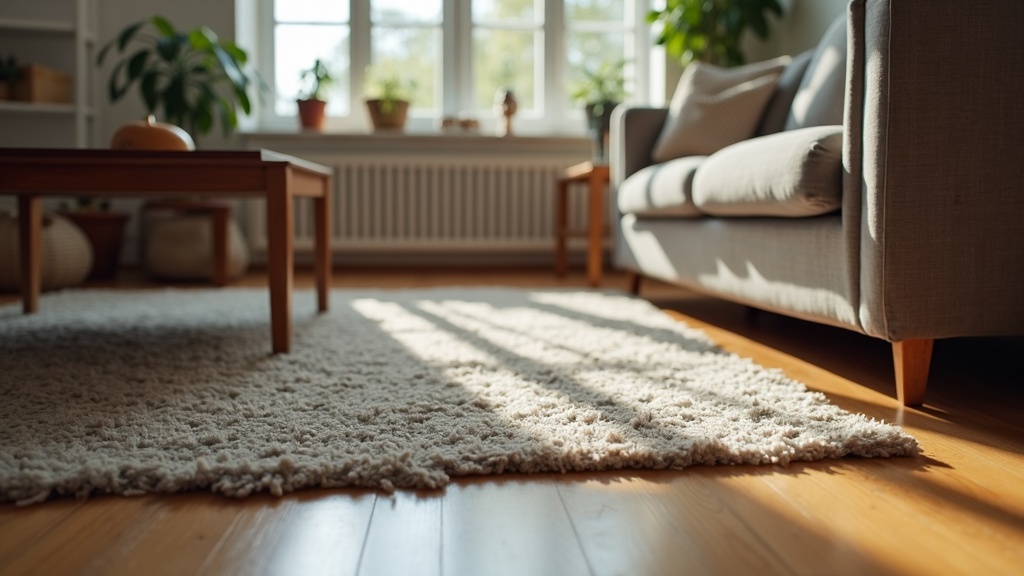
The best rug placement is the one you stop noticing. The room simply feels right, the furniture belongs together, and the light moves across the floor without interruption. That is lagom: not too much, not too little. Just enough, placed well.


