
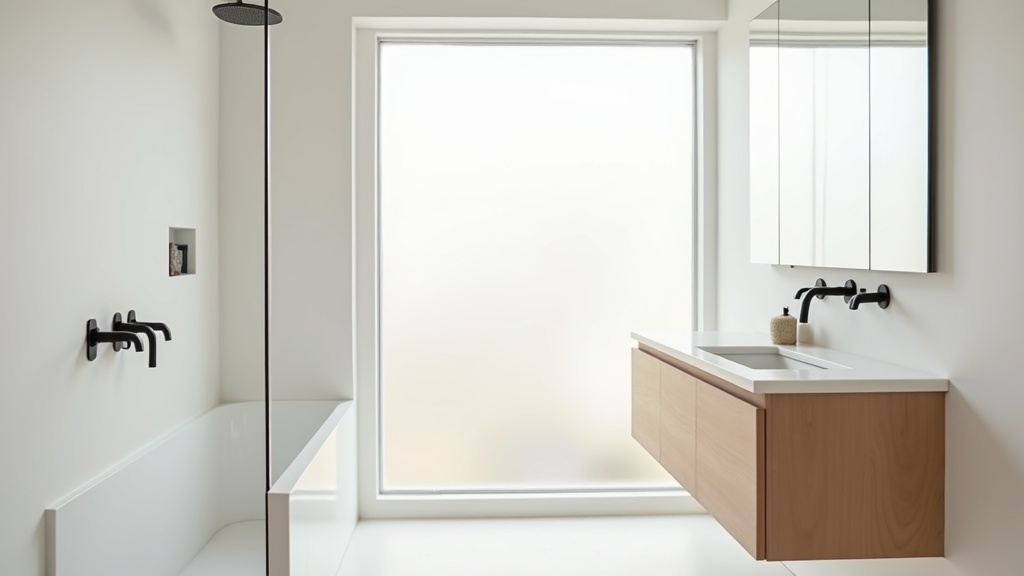
A bathroom that feels considered does not require a large budget. It requires good decisions, made in the right order.
Contemporary design, at its best, is already built for restraint: clean lines, honest materials, nothing that does not belong. That is also, quietly, a description of a budget done well.
Key points at a glance
- Contemporary style works naturally within a budget because it favors simplicity over decoration
- Lighting is the single highest-impact change you can make without touching the structure
- Swapping fixtures costs less than most people think and changes a room's entire register
- In a small bathroom, vertical space and clear sightlines do more than any extra square meter
- A focused shower update delivers outsized visual return relative to its cost
- Knowing what to skip is as valuable as knowing what to buy
What this approach gives you
Why Contemporary Design Works Better on a Budget Than Most Styles
Ornate styles need ornament to function. Traditional, maximalist, even rustic design asks you to fill space with things. Contemporary asks you to clear it.
That restraint is not a compromise. It is the point. Fewer elements, chosen carefully, feel more expensive than many elements chosen in haste. A simple bathroom with one good light fitting and a clean vanity reads as deliberate. The same room overloaded with accessories reads as noise.
Contemporary design also ages well. A room built on clean geometry and neutral materials does not date the way a trend-led room does. That is good value, measured over years.
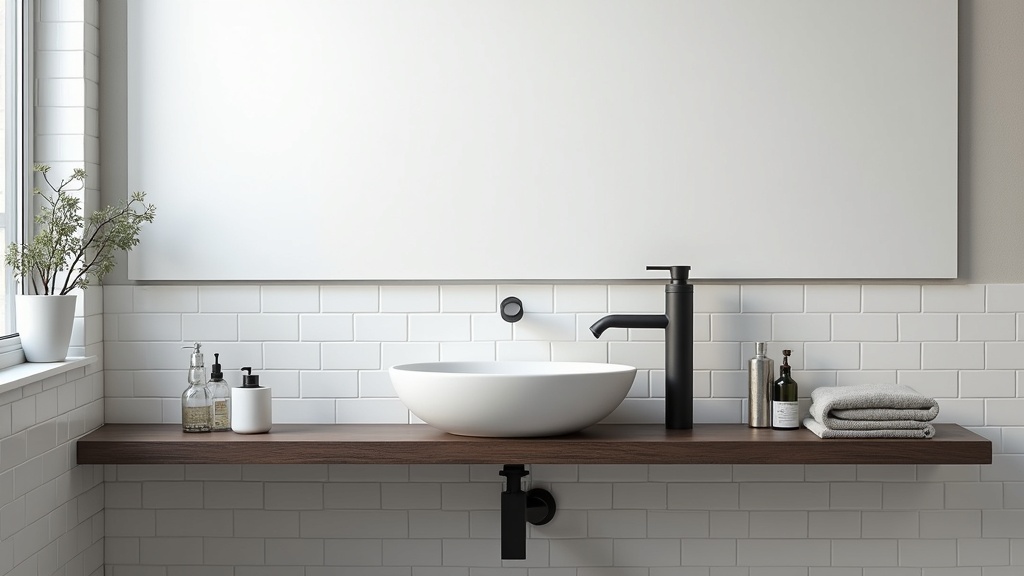
Start With Light: The Free Fix Most People Skip
Good lighting does not announce itself. It settles into the room and changes how it feels.
Most bathrooms suffer not from bad design but from one overhead bulb doing all the work. That single source creates flat, unflattering light and makes the room feel institutional.
Two changes, low cost
- Switch the bulb colour temperature to 2700K, 3000K. Warm white, not daylight. The difference is immediate and the cost is under five euros.
- Add a second light source at eye level. A simple wall-mounted fitting beside or above the mirror distributes light evenly and removes the shadows that make a bathroom feel dim.
If you can add a dimmer switch, do it. The ability to lower the light in the evening is a small luxury that costs very little and changes the feel of the room entirely.
Did you know?
Lighting accounts for up to 40% of how spacious a room feels, according to environmental psychology research. A well-lit small bathroom consistently feels larger than a poorly lit medium one.
The Fixtures That Do the Most Work (Swap These First)
Fixtures are the hardware of a bathroom. They are also the things your hands and eyes land on every single day.
Swapping taps, a showerhead, towel rails, and cabinet handles in a consistent finish takes a bathroom from mismatched to considered. Matte black, brushed nickel, and warm brass all read as contemporary and are now widely available at accessible price points.
Prioritise in this order
- Basin tap (most visible, most touched)
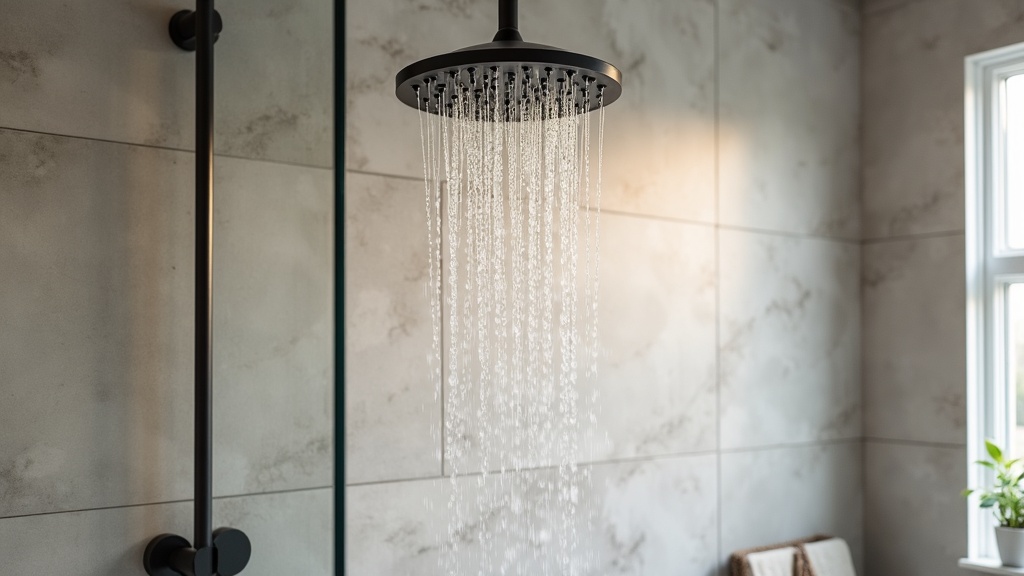
- Showerhead (a rainfall or wide flat head changes the shower experience and costs from around €30)
- Towel rail (choose one finish and commit to it throughout)
- Cabinet or drawer handles (small detail, large visual effect)
| Fixture | Typical budget cost | Visual impact |
|---|---|---|
| Basin tap | €25, €80 | Very high |
| Showerhead | €30, €70 | High |
| Towel rail | €20, €60 | Medium-high |
| Cabinet handles | €5, €20 per handle | Medium |
| Mirror | €40, €120 | Very high |
Small Contemporary Bathroom Design on a Budget: What Changes Everything
In a small bathroom, every decision has more consequence. The good news: the same rules that govern good contemporary design also govern good small-space design.
Keep the sightline clear. Anything that visually interrupts the floor-to-wall transition makes a room feel smaller. A floating vanity (wall-mounted, with open space below) frees the floor and the eye. You can find these from €150 upward.
Three principles for small spaces
- One large mirror, not two small ones. A single mirror across the full width of the vanity doubles the sense of depth.
- Vertical tile lines draw the eye up and give the impression of height.
- Recessed shelving wherever the wall allows: zero floor footprint, clean look.
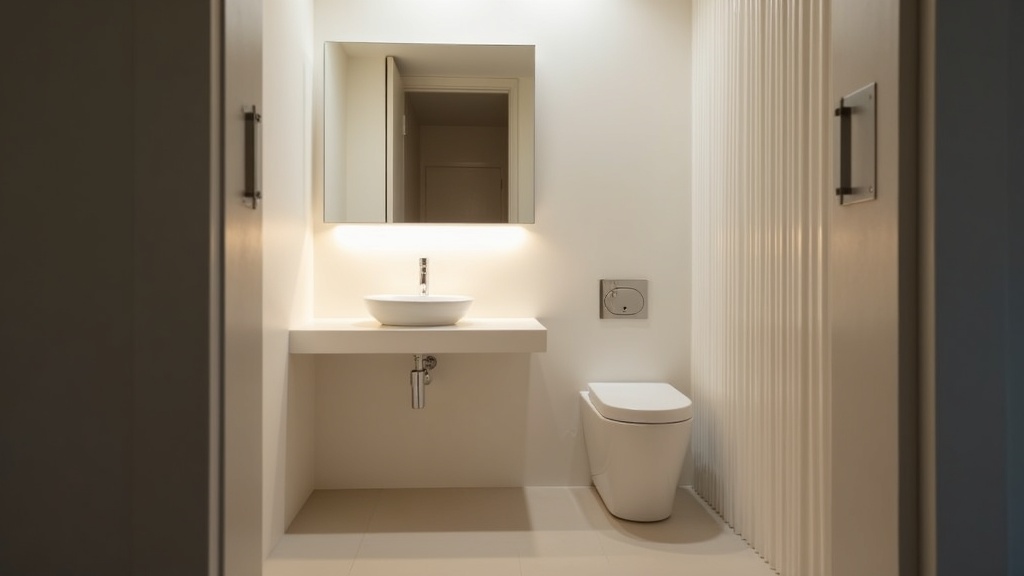
Color, Tile, and Surface: How to Look Expensive Without Spending It
The palette for a budget contemporary bathroom is narrow by design. White, off-white, warm grey, stone tones. One accent, if any.
This is not timidity. It is lagom: not too much, not too little. A room with too many competing colours asks you to read it rather than rest in it.
Where to put tile money
- One feature wall with a slightly better tile does more than tiling everything with a cheap one
- Large-format tiles (60×60cm or bigger) reduce grout lines and make a room feel more open
- Matte finishes read as more considered than high-gloss at this price point
Paint the rest. A quality bathroom-grade paint in a warm white or soft greige costs very little and transforms walls that would otherwise look tired.
Did you know?
Large-format floor tiles (60×60cm and above) can make a bathroom appear up to 30% larger than the same room tiled with standard 20×20cm tiles, purely because of the reduced number of grout lines interrupting the visual field.
Contemporary Bathroom With Shower on a Budget: Focused Updates That Deliver
The shower is often the most-used part of a bathroom. It is also the part where a targeted update gives the most return.
You do not need to retile the entire shower enclosure. Replace the showerhead, the tap or valve, and the screen. A frameless or semi-frameless shower screen from a mid-range supplier costs €80, €200 and immediately changes the room's register from dated to clean.
If retiling is part of the plan
- Tile the shower wall only, not the full room: lower cost, same effect
- A single row of a textured or patterned tile at eye height adds character without covering every wall
- White grout stays contemporary. Dark grout can work but shows wear faster
Storage That Feels Calm, Not Cluttered
Clutter is the fastest way to undo good design. In a bathroom, storage is not optional. But the wrong kind of storage is almost worse than none.
Open shelving looks good in photographs and collects dust in real life. Closed storage, simply fronted, keeps surfaces clear and the room calm.
What works
- A mirrored cabinet above the basin: storage and light in one
- A slim tall cabinet in a corner: maximum storage, minimal footprint
- Hooks at the right height (door-mounted or wall-mounted) that are actually used
Leave one surface deliberately clear. One. A single candle, a small plant, nothing else. That restraint reads as confidence.
What to Ignore (And Where to Spend a Little More)
Knowing where not to spend is a skill. These things rarely justify the cost in a budget bathroom refresh:
- Designer towels (good-quality basics from a homeware store do the same job)
- Heated towel rails as a priority (nice, but secondary to lighting and fixtures)
- Statement basins if the rest of the room cannot support them
Spend a little more on: the mirror (it is in every photograph and every morning routine), the tap (it is touched every day), and the grout (cheap grout colours and stains fast).
Your starting point: a practical sequence
Work through this in order and you will spend less, get more, and avoid the paralysis of trying to do everything at once.
- Fix the light first. Bulb colour, second source, dimmer if possible.
- Paint the walls in a warm white or stone tone.
- Replace the tap and showerhead in a consistent finish.
- Upgrade the mirror (larger than you think you need).
- Address storage so surfaces can stay clear.
- Add the details last: handles, hooks, towel rail, one plant.
That is a contemporary bathroom refresh that actually works. Not too much, not too little. Just enough, done well.


