
A plant on your desk is not decoration. It is a quiet decision about how you want to feel while you work. The right one changes the temperature of a room without touching the thermostat.
This guide is built around specificity: which plants, which spots, which habits. Not a list of thirty options you will never remember, but a short, considered edit of what genuinely earns its place in a home office.
Key points at a glance
- The best plants for home office productivity are low-maintenance, compact, and tolerant of indoor light conditions.
- Snake plants, pothos, and ZZ plants thrive with zero fuss, even in low-light rooms or offices with no windows.
- Several common desk plants actively filter volatile organic compounds from the air while you work.
- Research links exposure to indoor greenery with measurable drops in cortisol and perceived stress.
- Placement matters as much as plant choice: one well-placed plant beats five crowded ones.
- A simple weekly care routine of two to three minutes is all most of these plants need.
What plants give you at your desk
Why Plants Belong in a Home Office (Not Just for Looks)
A plant placed well does more for a room than a scented candle or a motivational print. It introduces something alive, something that changes imperceptibly across the day as light shifts.
The benefit is not aesthetic in the Instagram sense. It is more physical than that. Studies consistently show that even brief visual contact with greenery reduces heart rate and lowers self-reported stress. In a home office where the boundary between work and rest is already thin, that matters.
What to Consider Before You Buy: Light, Space, and Habit
Three questions before any purchase: How much light does your room actually get? How much desk space can you genuinely spare? And how often will you realistically remember to water?
Honest answers to those three cut the options fast. A plant that needs bright indirect light will quietly die in a north-facing box room. A sprawling monstera will crowd a small desk within a season.
Light: the real constraint
Natural light is not binary. A room can have a window and still be too dark for most plants. If you cannot comfortably read a book by the light near your desk at noon, assume low light. Choose accordingly.
Space: lagom applies here
One considered plant sits better than three competing ones. A small desk plant for productivity should complement your setup, not compete with your monitor for visual attention.
The Best Plants for Home Office Productivity, Room by Room
The right plant depends on where your home office actually is. A converted spare bedroom behaves differently from a kitchen corner or a basement studio.
- Bright south or west-facing room: pothos, spider plant, peace lily, rubber plant
- Medium indirect light (east-facing): snake plant, ZZ plant, Chinese evergreen
- Low light or no windows: ZZ plant, cast iron plant, heartleaf philodendron
- Compact desk with limited space: succulents, air plants, small snake plant cultivars like 'Hahnii'
Did you know?
A 2019 study published in the Journal of Physiological Anthropology found that interacting with indoor plants for just a few minutes significantly reduced both psychological and physiological stress compared to a computer task of equal duration. The effect was consistent across participants regardless of whether they described themselves as plant lovers.
The Best Desk Plants for Small Spaces and Low Light
Most home office desks are not large. The plants that earn a permanent spot are the ones that stay contained, ask for little, and look considered rather than crowded.
Snake plant (Sansevieria trifasciata 'Hahnii')
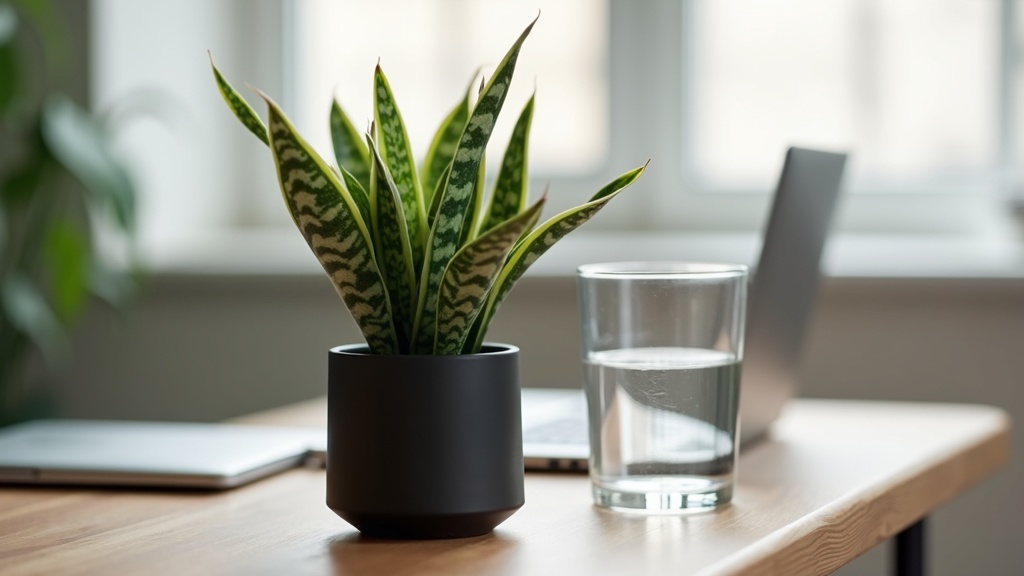
The compact 'Hahnii' cultivar stays under 25 cm tall. It tolerates low light and infrequent watering better than almost any other indoor plant. Water it once every two to three weeks and it will outlast most office furniture.
ZZ plant (Zamioculcas zamiifolia)
Deep green, architectural, and genuinely drought-tolerant. A ZZ plant stores water in its rhizomes, so forgetting it for a month causes no damage. One of the strongest performers for office plants with no windows.
Pothos (Epipremnum aureum)
Trailing, fast-growing, and forgiving. A small pot on a shelf above the desk allows the vines to cascade gently without occupying workspace. It handles low light and irregular watering with quiet resilience.
Air plants (Tillandsia spp.)
No soil required. They sit in a small ceramic or wooden holder, mist once a week, and occupy almost no space. A good choice when the desk is already at capacity.
Plants That Help Clean the Air While You Work
The air in a sealed home office collects volatile organic compounds from furniture, paint, and electronics. Some plants absorb a measurable portion of these compounds through their leaves and root systems.
The most effective species for air filtration include: peace lily, spider plant, rubber plant, and Boston fern. These are among the best plants for office air cleaning according to research that began with NASA's Clean Air Study in 1989 and has been refined since.
| Plant | Light needed | Air filtering | Care level |
|---|---|---|---|
| Snake plant | Low to bright indirect | Formaldehyde, benzene | Very low |
| Peace lily | Low to medium | Acetone, ammonia, benzene | Low |
| Spider plant | Medium to bright indirect | Formaldehyde, xylene | Low |
| ZZ plant | Low to medium | Toluene, xylene | Very low |
| Rubber plant | Bright indirect | Formaldehyde | Low to medium |
| Boston fern | Medium indirect | Formaldehyde, xylene | Medium |
Do Plants Actually Lower Cortisol? What the Research Says
The short answer: yes, with caveats. Multiple studies have measured salivary cortisol in participants who worked near plants versus those who did not. The plant group consistently showed lower stress markers after identical task loads.
The effect is not dramatic enough to replace good sleep or a reasonable workload. But it is real, consistent, and costs almost nothing to implement. For plants that reduce stress at work, the evidence points most clearly toward broad-leaved green species rather than succulents or cacti, possibly because leafy plants trigger deeper biophilic associations.
Did you know?
Research from the University of Exeter found that employees working in offices enriched with plants reported a 15% increase in productivity compared to those in lean, plant-free environments. Attention restoration theory suggests that soft, natural stimuli like plants allow the prefrontal cortex to recover from directed-attention fatigue more quickly than a blank wall.
How to Place a Plant for Maximum Calm (Not Clutter)
Placement is the part most guides skip. A plant in the wrong spot becomes noise. One placed with intention becomes part of how the room feels.
The 45-degree rule
Position a plant so it sits at the edge of your field of vision when you are looking at your screen, roughly 45 degrees to one side. Your peripheral vision registers it without your focus being pulled away. That low-level awareness of something living is where most of the calming effect comes from.
Height matters
A plant at eye level when seated reads as a presence in the room. A plant at floor level reads as furniture. For a desk plant specifically, something between 20 and 40 cm tall holds the ideal visual weight without dominating the surface.
A Simple Care Routine That Fits Around Your Workday
The best low maintenance indoor plants for office spaces need almost nothing. The routine below works for snake plants, ZZ plants, pothos, and most others on this list.
- Monday morning: Check the soil with one finger. Dry to 2 cm depth? Water until it drains. Still damp? Leave it.
- Every two weeks: Wipe dust from large leaves with a damp cloth. Dust blocks light absorption.
- Once a month: Rotate the pot a quarter turn so all sides receive even light.
- Seasonally: Reduce watering frequency in winter by about 30%. Most indoor plants slow their growth and need less.
That is roughly three minutes a week. Less time than it takes to make a coffee. And a well-cared-for plant on your desk is a quiet signal to yourself that the workspace is somewhere worth maintaining.


