
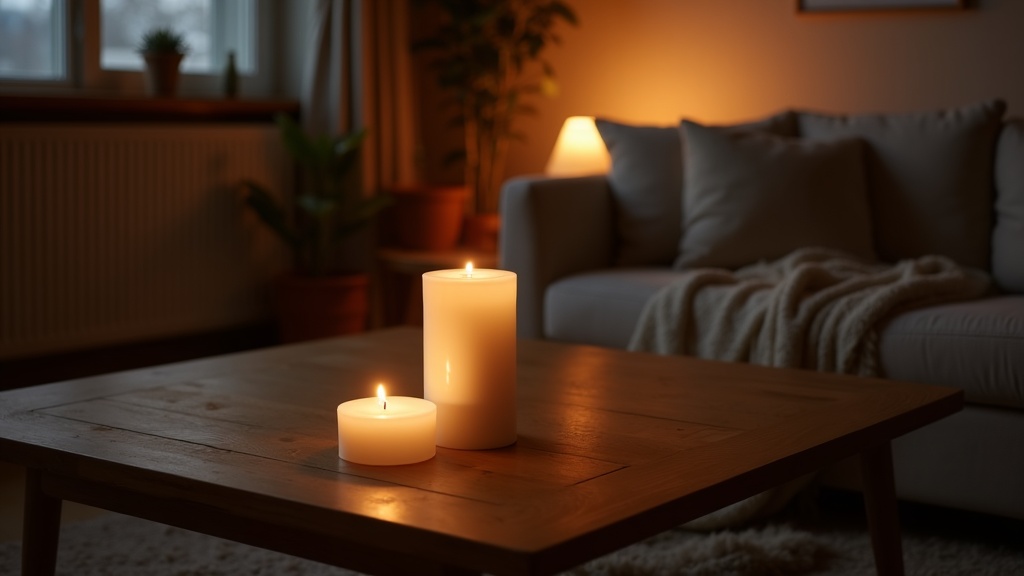
You light a candle before dinner and the room shifts. Not brighter, just different. Something settles. That's not imagination, and it's not nostalgia. It's physics meeting biology in a very specific way.
This is a practical look at candlelight versus electric lighting for ambiance, what each actually does, where each falls short, and how to use both well. No mood boards, just decisions you can act on tonight.
Key points at a glance
- Candlelight flickers between 1,800 and 2,000 Kelvin, far warmer than any standard bulb, and that warmth is what makes a room feel safe and settled.
- Electric lighting can come close to candle quality, but only when you choose the right bulb: 2,200K, high CRI, dimmable.
- Layering both sources, candles for intimacy and dimmed electrics for background fill, consistently outperforms either alone.
- Candles are not cheaper than electricity for regular use, but their value is sensory, not economic.
- The Scandinavian approach (many small light sources, low and warm) is the most replicable model for calm home ambiance.
- Flameless LED candles have genuinely improved and work well where real flame is impractical.
What good ambiance lighting actually gives you
The Real Difference Between Candlelight and Electric Light
The gap is not just warmth. It's movement, color rendering, and source size.
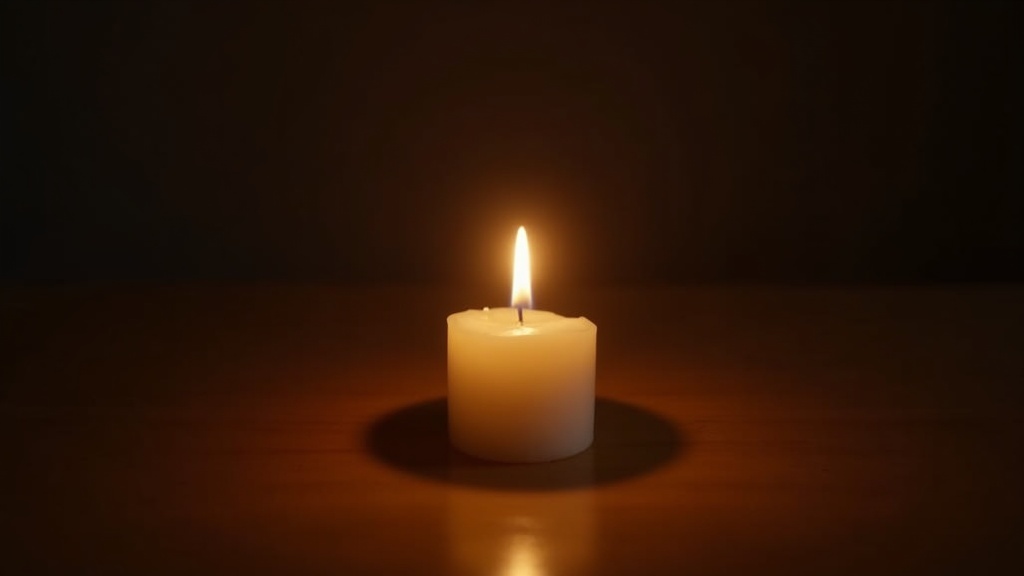
A candle flame flickers between 1,800 and 2,000 Kelvin, shifting constantly. That micro-variation keeps the eye softly engaged without demanding attention. Electric light, even at a warm 2,700K, holds perfectly still. Our brains register that difference, even when we don't consciously notice it.
Candlelight also renders colors differently. It enhances warm tones, wood, skin, linen, terracotta, while letting cooler surfaces recede. A room lit by candles looks edited, even if nothing has moved.
What Candlelight Actually Does to a Room (and to You)
Dim, warm light triggers a different neurological response than bright, cool light. Cortisol drops. Melatonin starts to rise. The body begins its wind-down sequence.
Candlelight pools. It doesn't fill a room evenly. That pooling creates zones, a lit circle here, shadow there, and our nervous systems read that as safe enclosure rather than exposed space. It's the same reason firelight felt protective for ten thousand years.
Did you know?
Research published in the Journal of Environmental Psychology found that people in rooms with dim, warm lighting reported feeling more relaxed and made more socially cohesive decisions than those in bright overhead-lit rooms, even when temperature and noise levels were identical.
Where Electric Lighting Falls Short for Ambiance
Most homes are overlit. A single ceiling fixture at full brightness floods the room uniformly. That flatness is the problem: no shadow, no depth, no visual hierarchy.
Cool-white bulbs (4,000K and above) actively work against relaxation. They're useful for reading a contract. They're not useful for a Tuesday evening when you want to feel human again.
Even dimmed, a ceiling-only electric setup casts light from above, the same angle as harsh daylight. It flattens faces, makes rooms feel like waiting rooms, and does nothing for texture on walls or fabric.
Is Candlelight Cheaper Than Electricity? The Honest Answer
No, not for regular use. A quality pillar candle burns for roughly 60 to 80 hours and costs anywhere from two to fifteen euros depending on quality. That per-hour cost outpaces a dimmable LED easily.
But the question misses the point. You don't light a candle to save money. You light it because the quality of those 90 minutes is different, and that has real value.
If cost genuinely matters, use one good candle as an accent, not as your primary light source. Let the electric system carry the room; let the candle do the mood work.
Which Electric Bulbs Come Closest to Candlelight
This is where specifics matter. Not all warm bulbs are equal.
- Color temperature: Choose 2,200K to 2,400K. Standard "warm white" at 2,700K is a starting point, but 2,200K is noticeably closer to flame.
- CRI (Color Rendering Index): Aim for 90 or above. A high CRI means colors look true and rich, not washed out.
- Dimmability: Non-negotiable. A fixed-brightness warm bulb is still a fixed-brightness warm bulb. You need range.
- Filament style: LED filament bulbs (visible filament, amber glass) tend to have a more diffuse, omnidirectional glow that mimics incandescent light closely.
- Avoid: Any bulb labelled "daylight" or "cool white" for evening ambiance rooms.
| Bulb type | Color temp | Best for | Ambiance rating |
|---|---|---|---|
| LED filament (amber) | 2,200K | Side lamps, sconces | ★★★★★ |
| Dimmable warm LED | 2,700K | Floor lamps, ceiling | ★★★★☆ |
| Standard warm white LED | 3,000K | Kitchen, utility | ★★★☆☆ |
| Cool white LED | 4,000K | Office, workshop | ★☆☆☆☆ |
| Daylight LED | 5,000, 6,500K | Detail tasks only | ✗ Not suitable |
How to Layer Both Light Sources for a Calmer Home
Good lighting doesn't announce itself. It settles into the room and changes how it feels.
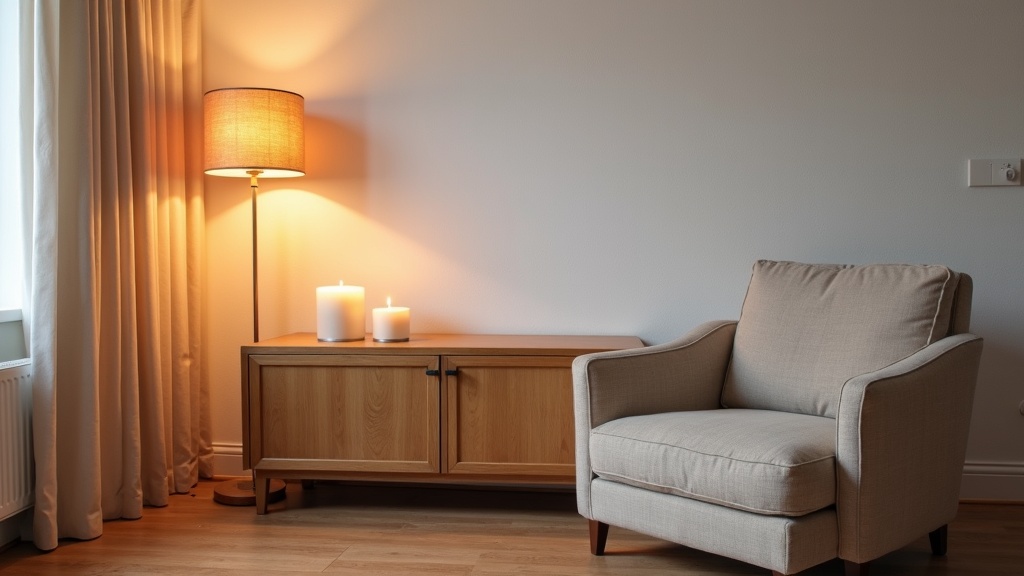
The principle is simple: use electric light for the room, candles for the moment. A dimmed floor lamp at 2,200K provides enough background fill to move safely and read comfortably. Two or three candles on the table or shelf then pull the eye down and in, creating the intimacy.
A practical layering approach
- Set all ceiling fixtures on dimmers and keep them at 20 to 30% during evenings.
- Place one floor lamp in the corner, not directly above seating.
- Add a small table lamp at seated eye-level or lower.
- Light two to three candles at table height or on a low shelf.
- Turn off any overhead light that isn't dimmed.
When Candles Make Sense, and When They Don't
Candles work when you're present, unhurried, and can watch them. They don't work when you leave the room for an hour, have young children running nearby, or want ambiance lighting that simply stays on through the evening without management.
Flameless LED candles have genuinely improved. The best ones (look for a wax exterior and a flickering, warm-toned flame simulation) are now convincing enough for windowsills, bookshelves, and bathrooms where open flame is impractical. They're not identical to real candlelight, but they're a serious option, not a compromise.
Did you know?
In Sweden, Danes light an average of 35 to 40 candles per person per week during winter months, the highest rate in the world. The practice is directly tied to the cultural concept of hygge and the Swedish equivalent, mysigt, both of which center on warmth, closeness, and sensory calm rather than decoration.
The Scandinavian Approach: Just Enough Light
Swedish interior design doesn't chase drama. It works with lagom: not too much, not too little, exactly what is needed.
Applied to lighting, that means many small sources rather than one large one, all warm, all low, all dimmable. No single fixture dominates. The room breathes. You stop thinking about the light and start feeling the room.
The principles, distilled
- Light placed below eye level reads as intimate. Light above reads as functional.
- Three to five separate light sources in a living room outperform one bright ceiling fixture every time.
- Shadows are not a problem to solve. They give a room depth.
- A single candle on a wooden tray signals intentionality more than any pendant lamp.

Start here, tonight
You don't need new lamps. You need to change what you turn on and when.
- Switch off the ceiling light after 6 pm. Use only what's at seated height or below.
- Replace one bulb in your main living room lamp with a 2,200K LED filament bulb this week.
- Light one candle before dinner, even when eating alone. See how the room responds.
- If open flame isn't possible, buy one quality flameless candle with a real wax body and a timer function. Place it somewhere you sit for more than twenty minutes.
- Dim before you sit down, not after. The habit shifts how you enter a space.


