
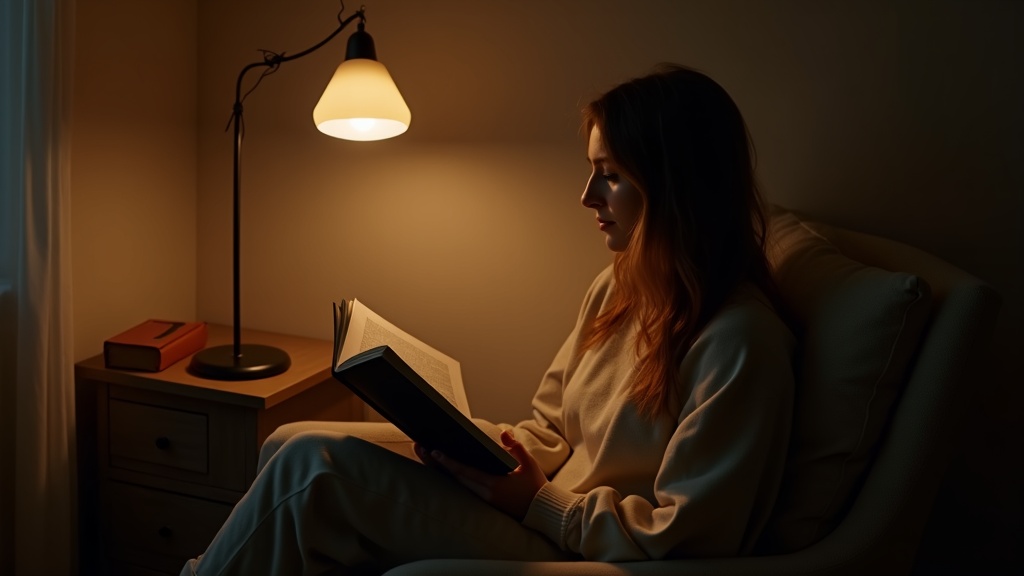
Most reading fatigue has nothing to do with how long you read. It has to do with where your light is coming from. A lamp placed wrong, even a beautiful one, will have your eyes working against themselves all evening.
The good news: lamp placement is not complicated. A few deliberate adjustments, maybe ten minutes, and the difference is immediate. Your eyes relax. The page becomes easy. The room feels quieter, somehow.
Key points at a glance
- Light should come from behind or to the side, never from in front of your eyes.
- For most people, the lamp belongs on the non-dominant side to avoid hand shadows.
- The ideal lamp height places the bulb just above eye level when seated.
- A 30-degree angle between the light source and the page minimises reflected glare.
- Ambient background light matters as much as the reading lamp itself.
- A floor lamp behind your shoulder can work as well as, or better than, a table lamp in many spaces.
What good placement actually gives you
Why Lamp Position Matters More Than Lamp Wattage
People spend time choosing the right bulb, the right colour temperature, the right wattage. Those things matter. But a well-chosen bulb placed in the wrong position will still cause glare, still create shadows, still leave your eyes tired by nine o'clock.
Position is the variable most people forget to adjust. A 40-watt bulb at the right angle does more for comfortable reading than a 100-watt bulb aimed directly at your face.
The Core Rule: Light Over the Shoulder, Not in Your Eyes
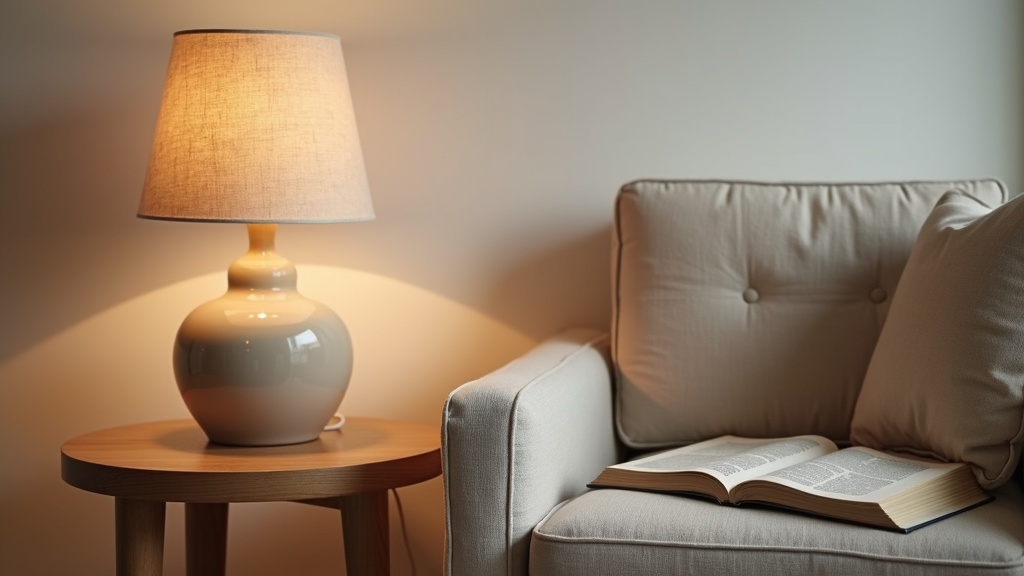
This is the principle everything else follows from. The light source should never be visible when you look up from the page. If you can see the bulb or a strong glow directly in your line of sight, the lamp is in the wrong position.
Light coming from behind and slightly above your shoulder illuminates the page evenly. It does not compete with your eyes. It simply does its work and steps aside.
Which Side Should Your Lamp Go On?
The standard guidance: place the lamp on the side opposite your dominant hand. If you write or turn pages with your right hand, the lamp goes to your left. This way, your hand never casts a shadow across what you are reading.
There is nuance here. If you read in bed and your partner is on your right, placing the lamp to the left may not be practical. In that case, a directional clip lamp or a lamp with a deeply focused shade is a better tool than a standard table lamp in a compromising position.
Did you know?
Studies from the American Optometric Association show that reading under high-contrast lighting conditions, where one area is bright and the surrounding room is dark, forces the eyes to constantly readjust and is a leading cause of digital and print reading fatigue. A soft ambient light source elsewhere in the room reduces that contrast and eases the strain significantly.
Getting the Height Right: The Eye-Level Principle
Sit in your reading position. Note where your eyes fall naturally. The bottom edge of your lamp shade should be roughly at that height, or just above it. This keeps the bulb hidden by the shade and ensures light falls onto the page, not into your face.
A shade that sits too low throws most of the light forward and upward, directly toward your eyes. Too high, and the illuminated area narrows to a small pool that may not cover the page comfortably.
The practical test
- Sit down as you normally would to read.
- Look straight ahead at your usual reading angle.
- The bulb should not be visible. If it is, raise the shade or reposition the lamp further back.
- The light on the page should be even, not brighter at the top than the bottom.
The 30-Degree Angle and Why It Works
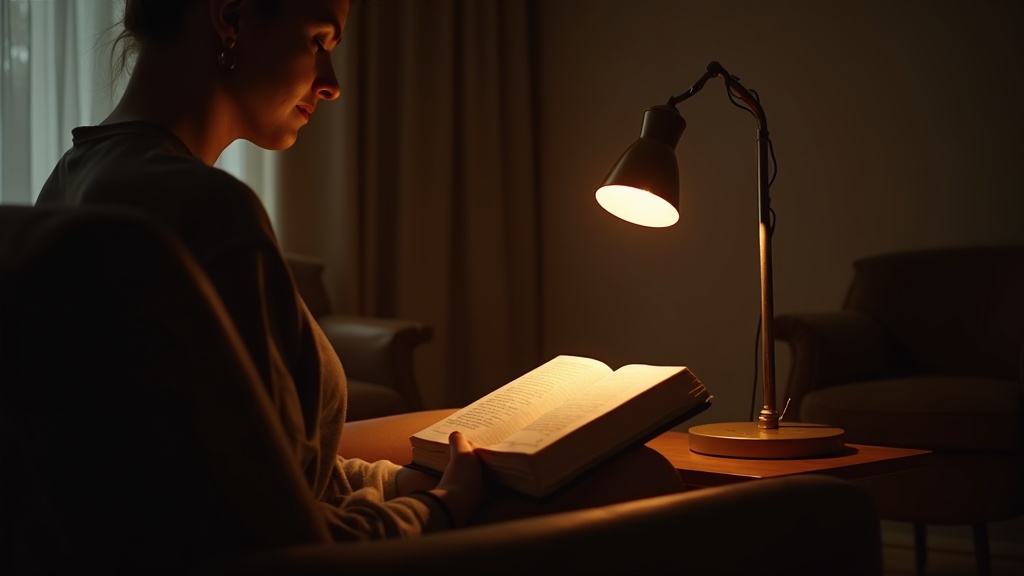
Glare from a page is reflected light. When light hits a surface and bounces back at the same angle it came from, it hits your eyes directly. A 30-degree angle of incidence, measured from vertical, reduces this reflection to a minimum.
In practice, this means the lamp should not sit directly beside you or directly behind you. It belongs at a slight diagonal, about 30 to 45 degrees from your line of sight toward the page. Think of it less as a spotlight and more as a soft, angled wash.
Common Placement Mistakes That Cause Glare
- Lamp placed in front of you, facing toward your eyes. This is the single most common mistake in desk setups.
- Lamp too close to the page. Proximity concentrates the light into a hot spot, raising the contrast between the lit area and the surrounding page.
- No ambient light elsewhere in the room. A single lamp in a dark room forces your pupils to work between two extremes every time you glance up.
- Glossy book covers or coated paper under direct light. The material of the page matters. Matte paper is always kinder to the eyes than gloss.
- Shade pointing downward at a steep angle. This creates a bright circle on the page and leaves the rest of your visual field in contrast-heavy darkness.
Did you know?
The human eye takes up to 20 minutes to fully adapt from a bright light to a darker environment. Reading in a single-source lit room and then looking toward a darker corner repeatedly throughout an evening is enough to cause measurable fatigue, even if each individual glance feels brief.
What the 5-7 Lighting Rule Actually Means for Reading
The 5-7 rule is a guideline from lighting designers: the reading surface should be between 5 and 7 times brighter than the ambient light in the rest of the room. Not ten times brighter. Not identical.
Too dark overall and the contrast between page and room strains the eyes. Too bright overall and the reading lamp loses its purpose. The sweet spot is a room that feels gently lit, with the reading area noticeably, but not harshly, brighter.
A low-wattage floor lamp or a dimmable wall sconce elsewhere in the room is often all you need to bring the background up to the right level.
Table Lamp vs. Floor Lamp: Which Works Better for Reading?
| Criteria | Table Lamp | Floor Lamp |
|---|---|---|
| Ideal height control | Depends on table height, less flexible | Adjustable arc models give full control |
| Over-the-shoulder angle | Achievable if table is positioned correctly | Naturally achieves the shoulder angle |
| Small spaces | Better, requires less floor footprint | Takes more floor space, less suited to tight corners |
| Glare risk | Higher if placed on a surface at eye level | Lower, light typically comes from above and behind |
| Aesthetic flexibility | Wide range of styles, suits most decors | Strong visual presence, suits open living rooms |
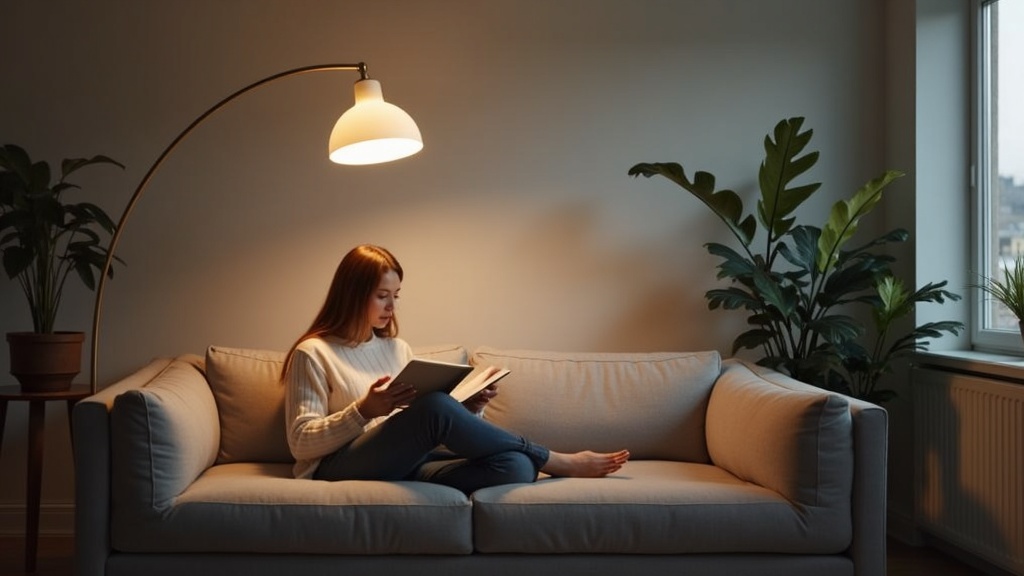
Neither is categorically better. A good arc floor lamp placed behind and to the side of your chair is often the most ergonomically correct reading light you can have at home. A table lamp works beautifully on a side table of the right height, with the right shade.
A Quick Checklist Before You Settle In to Read
Run through this before each session. It takes thirty seconds and makes a genuine difference.
- Lamp position: Is it behind or to the side of your shoulder, not in front of you?
- Shade height: Is the bulb hidden when you look straight ahead?
- Dominant hand: Is the lamp on the opposite side from your writing or page-turning hand?
- Ambient light: Is there at least one other light source on in the room, even dimly?
- Angle check: Tilt the shade slightly forward if light is spilling toward your face.
- Page surface: If reading on a tablet or e-reader, reduce screen brightness to match the room, not the lamp.
Good lighting does not announce itself. When the position is right, you simply read longer, more comfortably, without ever thinking about the lamp. That is exactly what it should feel like: just enough, placed well, doing its job quietly.


